Supratim Chatterjee
Concordia University, Second Place Winner
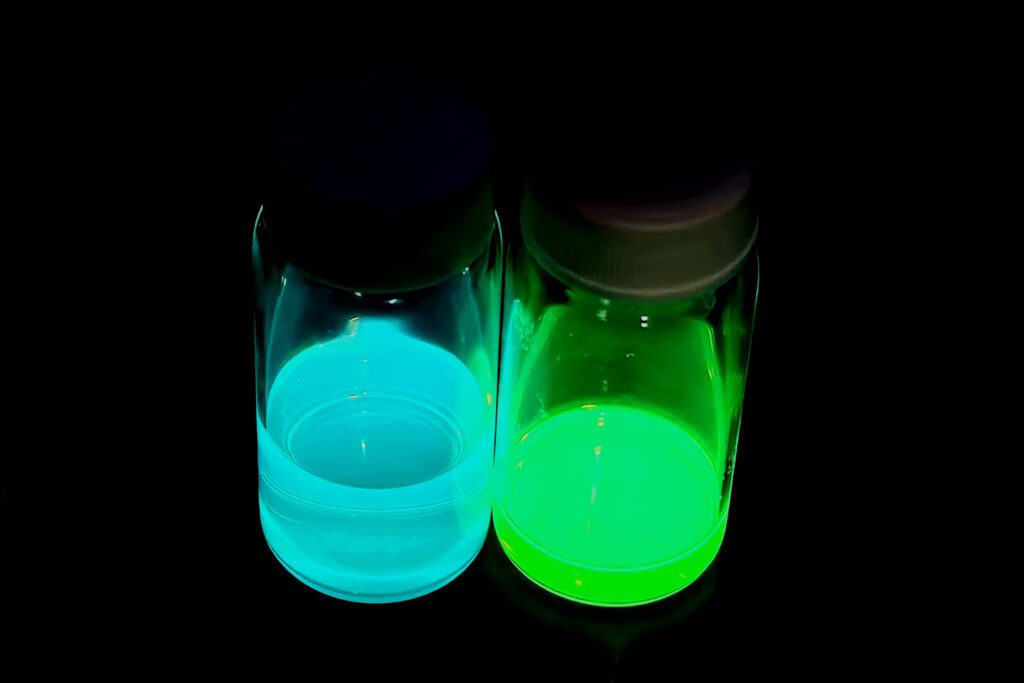
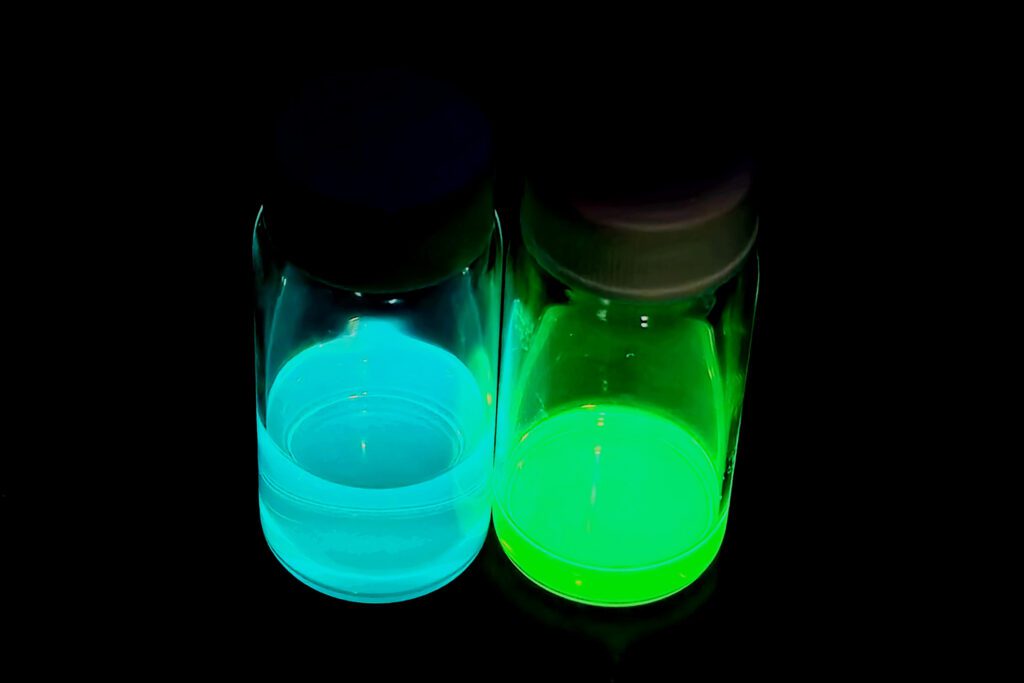
Tuned by Size, Revealed by Light: Exploring Perovskite Photoluminescence. Two size-fractionated CsPbBr₃ nanocrystal dispersions photographed under 365 nm UV light using a Samsung S24 (50 MP). Differences in particle size produce distinct green and cyan photoluminescence, captured without filters or post-processing. Image credit: S. Chatterjee.
Artist’s Statement:
This image emerged during my work on developing phospholipid-capped cesium lead bromide (CsPbBr3) perovskite nanocrystals, an effort motivated by the search for more stable, solution-processable perovskite materials. My research focused on the use of zwitterionic phospholipid ligands to improve the colloidal and environmental stability of these nanocrystals. While perovskites are remarkable for their bright emission and tunable optoelectronic properties, they are notoriously fragile. Using zwitterionic capping groups offers a promising route to protect the nanocrystal surface from degradation while maintaining efficient photoluminescence.
The image itself was taken during a routine step in my workflow: separating different size fractions of the same nanocrystal batch. After synthesizing the CsPbBr3 nanocrystals using a standard hot-injection method, the dispersions were subjected to differential centrifugation. Larger nanocrystals precipitated at 7850 rpm, while smaller ones were isolated at 10000 rpm. Although this is a common purification step, it also beautifully reveals one of the most fundamental principles of nanoscience: size controls color. The two vials in the image, one emitting green light, the other a cooler cyan, contain particles with nearly identical composition, yet their emission diverges simply because of their dimensions and surface states.
The photograph was taken with a Samsung S24’s 50 MP camera under a 365 nm UV lamp chamber. No filters or post-processing were used; the colors are exactly as the eye sees them. I often find that perovskites make their own art. Their photoluminescence is so bright and responsive that even quick snapshots during synthesis become visually striking. While the experimentalist in me is thinking about quantum confinement, trap states, and charge-carrier dynamics, the artist in me sees the scene as light being transformed, UV going in, color coming out.
The interaction between art and science in my work is natural and constant. Perovskite nanocrystals respond vividly to illumination, which makes every experiment feel like a small performance. This simple transformation embodies much of what my research aims to capture at a deeper level. Whether I am studying energy transfer processes, building hybrid nanostructures for photocatalysis, or exploring upconversion mechanisms, I am fundamentally working with systems that translate one form of energy into another. The image reflects this idea in its purest and most visual form.
Currently, my scientific work is expanding toward hybrid perovskite systems that facilitate efficient charge and energy transfer. This includes donor-acceptor assemblies, surface-functionalized nanocrystals, and materials designed for upconversion applications. From an artistic perspective, I am continually inspired by the colors produced by these materials. Even though my work is driven by fundamental and applied questions in nano chemistry, the beauty of these systems is impossible to ignore. Overall, the image captures the moment where routine synthesis, nanoscale structure, and pure optical emission meet, and for a brief moment, laboratory science becomes art.
Curious to learn more about Supratim’s work? Connect with him professionally on LinkedIn!