Jocelyn Sinclair

Jocelyn Sinclair, Ph.D., is a Journal Development Specialist with the Canadian Journal of Chemistry and Canadian Journal of Physics. As a synthetic chemist turned publishing professional, she is passionate about supporting academic communities through research dissemination and highlighting the people and institutions that move us forward.

Art in Science – The ChemiSTEAM Contest Winners of 2025

July 7, 2026 | 7 minute read

Meet the winners of the 2025 Canadian Society for Chemistry’s ChemiSTEAM contest, an annual event hosted and judged at the Canadian Chemistry Conference and Exhibition. The 2026 iteration was just hosted at this year’s x2026 Conference.

We reached out to learn more about the 2025 winners’ approach to science and art, and these particular images. The Canadian Journal of Chemistry will feature some of the CSC ChemiSTEAM winners on our covers—watch for them on future issues!

Interested in seeing your work on the cover of the Canadian Journal of Chemistry? Authors of all accepted manuscripts are invited to contribute images for consideration. Visit our Cover Image Submission page to learn more.

Kaitlyn Brown

Wilfrid Laurier University, First Place Winner

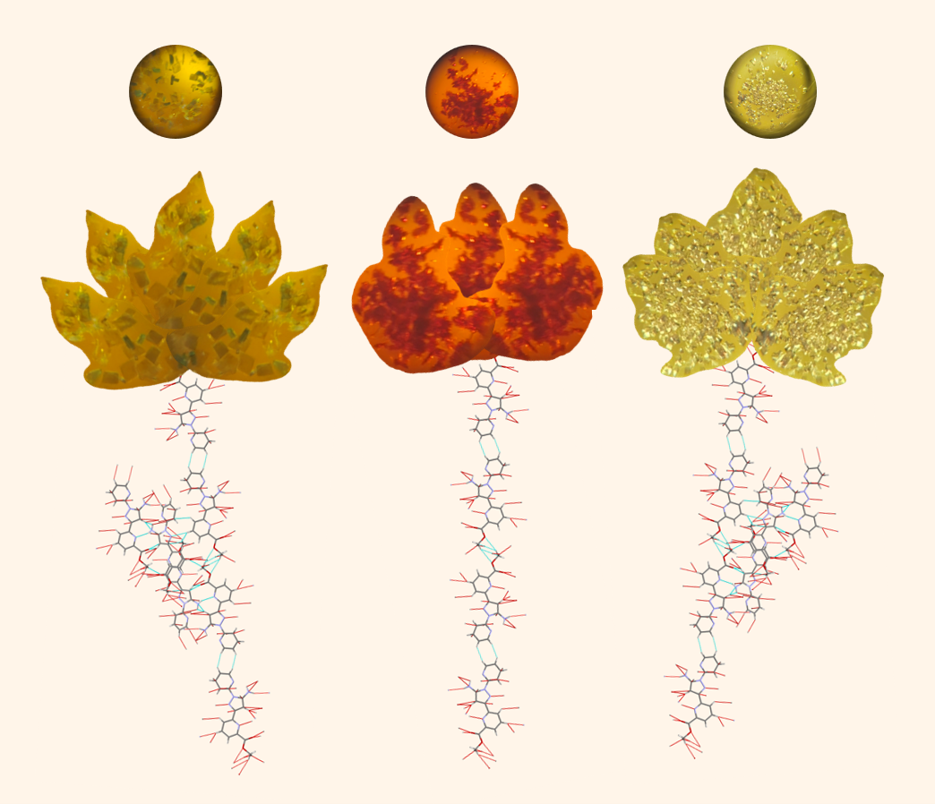
Crystals in Bloom. Crystals and flowers grow with delicate precision, inspiring beauty and wonder. Ligand complexed with Ni(CH3CO2)2•4H2O, Co(NO3)2•6H₂O, and NiCl2•6H2O. Photos taken under 60x magnification. Crystal structures visualized with Mercury software.

Artist’s Statement:

Crystals and flowers both grow with delicate precision. One grows in a lab, the other in a garden, yet both evoke feelings of excitement, beauty, and wonder. This image is composed of both photographs of crystals and visualization of their crystal structures. A ligand was synthesized and underwent complexation reactions with Ni(CH3CO2)2•4H2O, Co(NO3)2•6H₂O, and NiCl2•6H2O, respectively. Crystals of these complexes were formed via slow evaporation and photos were taken using a 60x magnification lens. The Cambridge Crystallographic Data Centre’s Mercury software was then used to identify short intermolecular contacts and visualize the extended chain structure.

To me, science and art have always been deeply connected, which is why I am passionate about both. Creativity, visualization, patience, and the ability to think beyond conventional ideas are essential qualities shared by each discipline. During the spring, I often find myself waiting for flowers to bloom, to see what they become and what beautiful colours they hold. At the same time, I was waiting for crystals to grow with the same sense of anticipation and curiosity.

At their core, both art and crystallography are built on shape and structure. As I examined my crystals, I noticed shapes that resembled flower petals, inspiring me to merge these two passions into a single piece. This artwork reflects the connection between the natural elegance of crystal structures and the organic beauty of flowers, illustrating how science and art can inspire one another.

My research focused on the functional design of dissymmetric ligands for coordination with a focus on their synthesis and structural characterization. The investigation of structure-property relationships contributes fundamentally to the understanding required for the development of new molecules that advance the field of supramolecular chemistry. During this project, I explored the incorporation of oxygen donors into the ligand framework, which resulted in coordination of metals that had been previously unsuccessful.

Curious to learn more about Kaitlyn’s work? Visit the Dawe Research Group website or connect with Kaitlyn professionally on LinkedIn!

Follow the Canadian Journal of Chemistry for more chemistry community collaborations and new research!

Supratim Chatterjee

Concordia University, Second Place Winner
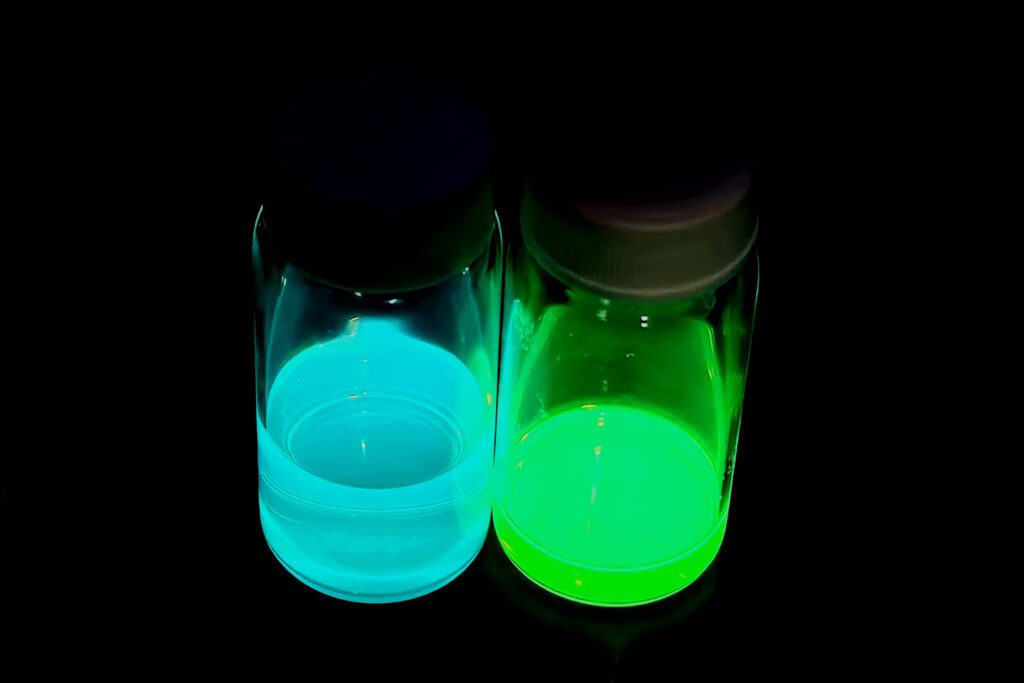
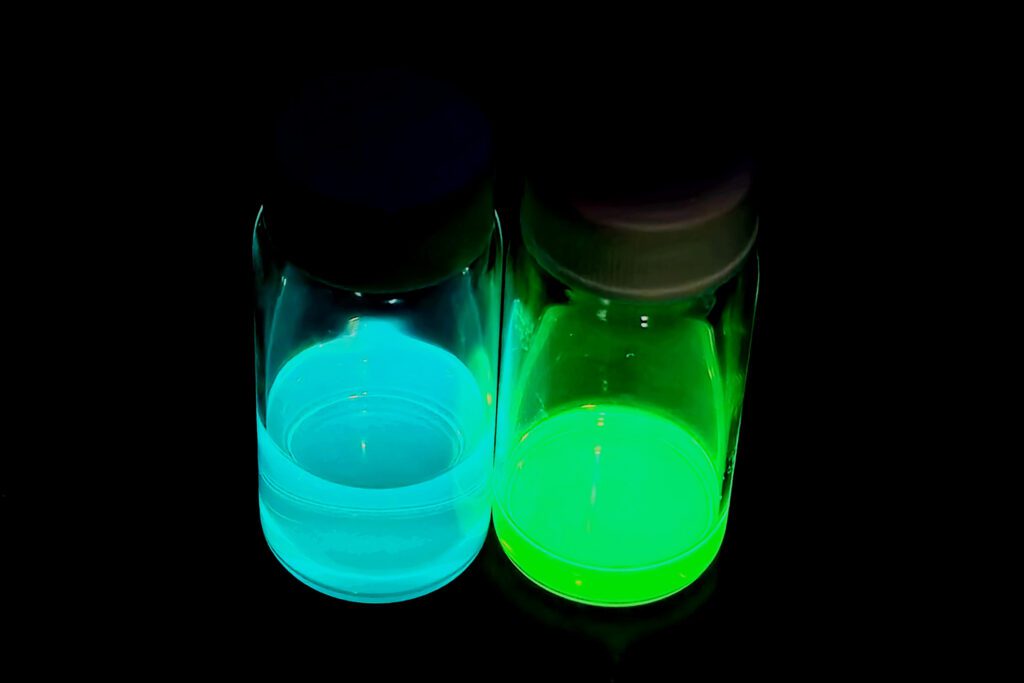
Tuned by Size, Revealed by Light: Exploring Perovskite Photoluminescence. Two size-fractionated CsPbBr₃ nanocrystal dispersions photographed under 365 nm UV light using a Samsung S24 (50 MP). Differences in particle size produce distinct green and cyan photoluminescence, captured without filters or post-processing. Image credit: S. Chatterjee.

Artist’s Statement:

This image emerged during my work on developing phospholipid-capped cesium lead bromide (CsPbBr3) perovskite nanocrystals, an effort motivated by the search for more stable, solution-processable perovskite materials. My research focused on the use of zwitterionic phospholipid ligands to improve the colloidal and environmental stability of these nanocrystals. While perovskites are remarkable for their bright emission and tunable optoelectronic properties, they are notoriously fragile. Using zwitterionic capping groups offers a promising route to protect the nanocrystal surface from degradation while maintaining efficient photoluminescence.

The image itself was taken during a routine step in my workflow: separating different size fractions of the same nanocrystal batch. After synthesizing the CsPbBr3 nanocrystals using a standard hot-injection method, the dispersions were subjected to differential centrifugation. Larger nanocrystals precipitated at 7850 rpm, while smaller ones were isolated at 10000 rpm. Although this is a common purification step, it also beautifully reveals one of the most fundamental principles of nanoscience: size controls color. The two vials in the image, one emitting green light, the other a cooler cyan, contain particles with nearly identical composition, yet their emission diverges simply because of their dimensions and surface states.

The photograph was taken with a Samsung S24’s 50 MP camera under a 365 nm UV lamp chamber. No filters or post-processing were used; the colors are exactly as the eye sees them. I often find that perovskites make their own art. Their photoluminescence is so bright and responsive that even quick snapshots during synthesis become visually striking. While the experimentalist in me is thinking about quantum confinement, trap states, and charge-carrier dynamics, the artist in me sees the scene as light being transformed, UV going in, color coming out.

The interaction between art and science in my work is natural and constant. Perovskite nanocrystals respond vividly to illumination, which makes every experiment feel like a small performance. This simple transformation embodies much of what my research aims to capture at a deeper level. Whether I am studying energy transfer processes, building hybrid nanostructures for photocatalysis, or exploring upconversion mechanisms, I am fundamentally working with systems that translate one form of energy into another. The image reflects this idea in its purest and most visual form.

Currently, my scientific work is expanding toward hybrid perovskite systems that facilitate efficient charge and energy transfer. This includes donor-acceptor assemblies, surface-functionalized nanocrystals, and materials designed for upconversion applications. From an artistic perspective, I am continually inspired by the colors produced by these materials. Even though my work is driven by fundamental and applied questions in nano chemistry, the beauty of these systems is impossible to ignore. Overall, the image captures the moment where routine synthesis, nanoscale structure, and pure optical emission meet, and for a brief moment, laboratory science becomes art.

Curious to learn more about Supratim’s work? Connect with him professionally on LinkedIn!

The Canadian Journal of Chemistry reports on all branches of chemistry, including interdisciplinary areas such as materials science, spectroscopy, chemical physics, and medicinal and environmental chemistry.

Piumi Kulatunga 

University of Windsor, Honourable Mention

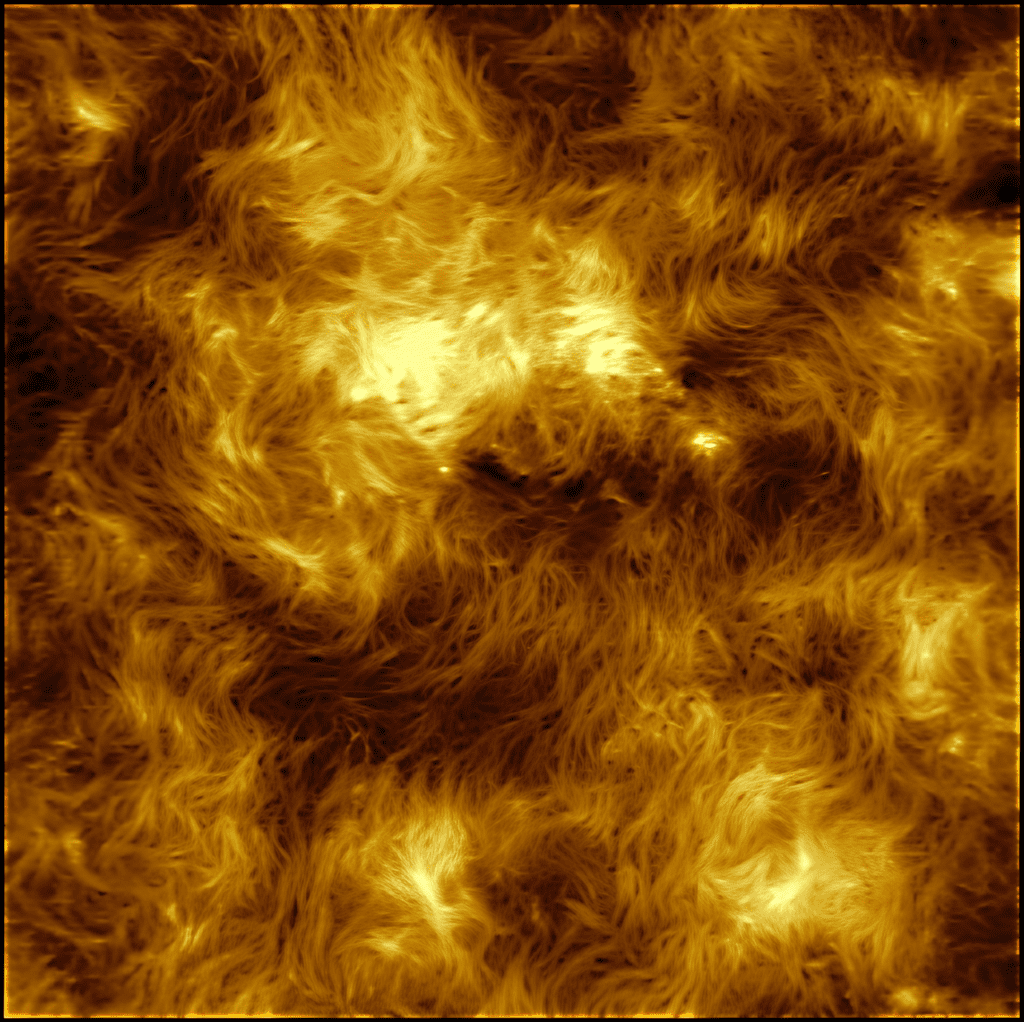
Collagen Threads: Weaving Sustainability into Electronics. The AFM image shows collagen’s fibrous, flexible structure, supporting our development of biodegradable, skin-inspired OFETs for eco-friendly, stretchable, implantable electronics. The image was captured by using a Multimode AFM in tapping mode, collected via Nanoscope 6, and processed in Gwyddion software. Image credit: P. Kulatunga, & S. Rondeau-Gagné.

Artist’s Statement:

This art piece was created during my research on developing biodegradable, biocompatible, and flexible organic field-effect transistors (OFETs). At the time, I was working in the Simon Rondeau-Gagné research group, where our broader focus is on designing next-generation stretchable and sustainable electronics. Within that context, my specific project centered on using naturally derived materials to create electronic devices that can bend, stretch, and eventually degrade safely, addressing both biological compatibility and the growing issue of electronic waste. Collagen, the most abundant protein in human skin, quickly emerged as an ideal candidate because of its intrinsic flexibility, structural strength, and ability to interact harmoniously with living tissues. 

The image itself was captured using atomic force microscopy (AFM), one of the most powerful tools for visualizing materials at the nanoscale. To prepare the sample, I first formed thin collagen films, ensuring they remained uniform and intact during imaging. I used a Multimode AFM operated in tapping mode to avoid damaging the delicate fibrillar structure. Images were collected using Nanoscope 6 software and later processed in Gwyddion to bring out the fine details of the collagen network. What I find most fascinating about this process is how AFM transforms a biological material, something normally soft, translucent, and invisible at the nanoscale, into an intricate and textured landscape. The fibrous collagen appears almost like woven silk, revealing the complex natural architecture responsible for its mechanical resilience. 

This AFM image was an important part of our published study, where we created a fully biodegradable and flexible OFET using collagen as the dielectric layer (ACS Applied Materials & Interfaces, 2025). The fibrous structure seen in the scan supports the material’s stretchability and controlled degradation, key features for wearable and implantable electronics. By using collagen’s natural architecture, we developed a transistor that mimics the softness and flexibility of human skin while also reducing long-term electronic waste. 

I continued to build on this work in the Rondeau-Gagné group, where I developed new organic materials and device architectures to advance stretchable, eco-friendly electronics. I am currently a postdoctoral researcher at KU Leuven. 

Curious to learn more about Puimi’s work? Visit the Rondeau-Gagné Research Group website or connect with Puimi professionally on LinkedIn!

Neha Bajaj

University of Ottawa, Honourable Mention

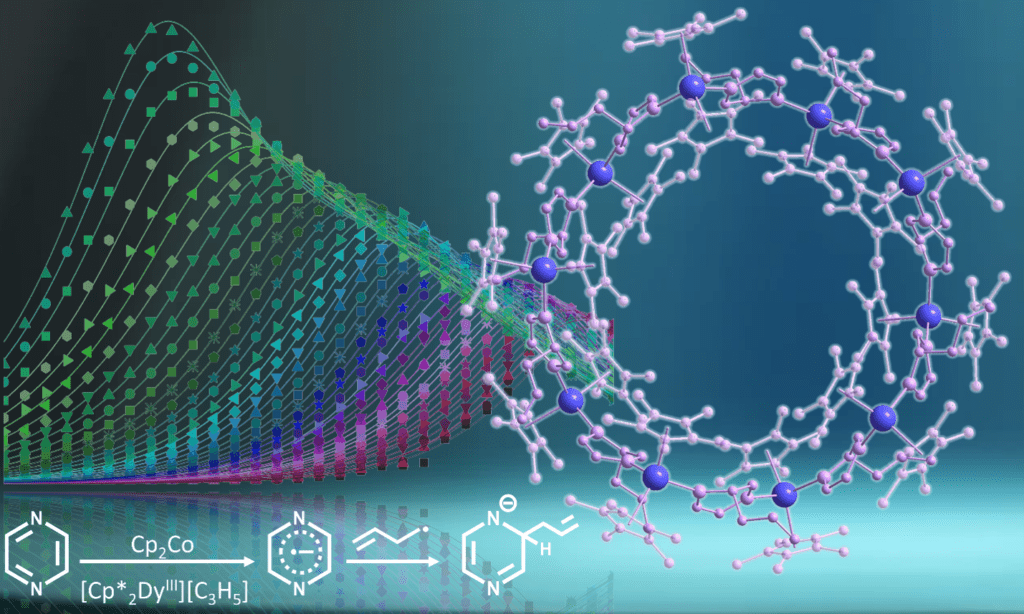
Spinning Up a Dysprosium Nano-Wheel. The image showcases a high-symmetry nanoscale decanuclear complex. AC susceptibility data in the background reveals slow magnetic relaxation, measured by SQUID magnetometry. The crystallographic structure was drawn using DIAM. Image credit: N. Baja, originally appeared under CC BY-NC-ND 4.0 license at https://doi.org/10.1002/anie.202411635

Artist’s Statement:

“Spinning up a Dysprosium Nanowheel” represents both a scientific moment and an artistic expression. It is my attempt to bring chemistry and art together and to highlight the beauty within the molecules that shape my work. My artwork emerged during a period when I was deeply immersed in my PhD research on lanthanide-based single-molecule magnets in the Murugesu Group at the University of Ottawa. My overarching project focuses on designing, synthesizing, and characterizing dysprosium complexes that exhibit slow magnetic relaxation systems with the potential to transform data storage and quantum information technologies. While my day-to-day research revolves around air-sensitive synthesis, crystallization, and magnetic characterization, I have always felt that the structures we build in the lab carry an inherent artistic beauty. The dysprosium nanowheel in particular, with its symmetry, complexity, and molecular elegance, naturally lent itself to artistic interpretation.

Curious to learn more about Neha’s work? Connect with her professionally on LinkedIn, Bluesky (@nehabajaj.bsky.social), and Twitter (@NehaBajaj98).

Artists’ responses have been edited for length and clarity by Jocelyn Sinclair, Journal Development Specialist at Canadian Science Publishing.

Jocelyn Sinclair

Jocelyn Sinclair, Ph.D., is a Journal Development Specialist with the Canadian Journal of Chemistry and Canadian Journal of Physics. As a synthetic chemist turned publishing professional, she is passionate about supporting academic communities through research dissemination and highlighting the people and institutions that move us forward.