

As a not-for-profit scholarly publisher, Canadian Science Publishing (CSP) reinvests every dollar to strengthen our journals and support our research communities. We ensure quality, integrity, and accessibility across all our journals. However, support for the processes, infrastructure, and the people that turn a manuscript into a permanent, trusted piece of the scholarly record does come at a cost. Integrity and openness are two of CSP’s core values, and we feel that transparency about what it truly costs to publish demonstrates our dedication to those values.
What it really costs to publish a research article
Our mixed model
Canadian Science Publishing supports its publishing operations through a mixed model that combines various approaches, including:
- Subscriptions to our hybrid journals
- Article Processing Charges (APCs) for our open access and hybrid journals
- Read and publish agreements with libraries and consortia which pay for both open access and subscriptions
- Discounts and waivers for open access articles, including our Research4Life partnership which enables free/discounted open access publishing for authors from Research4Life countries in CSP’s fully open access journals
- Green open access options where earlier versions of the article are posted in repositories or on other websites
- Ongoing efforts to secure funding to support diamond and green open access
Cost per article
CSP publishes only journals, so it is relatively straight-forward to calculate how much it costs us to publish an article. The cost per article is simply our total expenses divided by the total number of articles that we publish per year. Looking back on 2025, the cost per article was approximately $3,600 CAD (~$2,600 USD). Certain costs are fixed and do not change depending on how many articles we publish (e.g., our accounting system and human resources department will cost the same even if we publish many more articles). The exact cost per article varies across journals depending on factors such as the number of submissions a journal receives, formatting and production costs, and marketing and outreach activities.
Below, we provide transparency on the proportional breakdown of costs across our systems and workflows for submission and peer review, publication and dissemination, and support and sustainability.
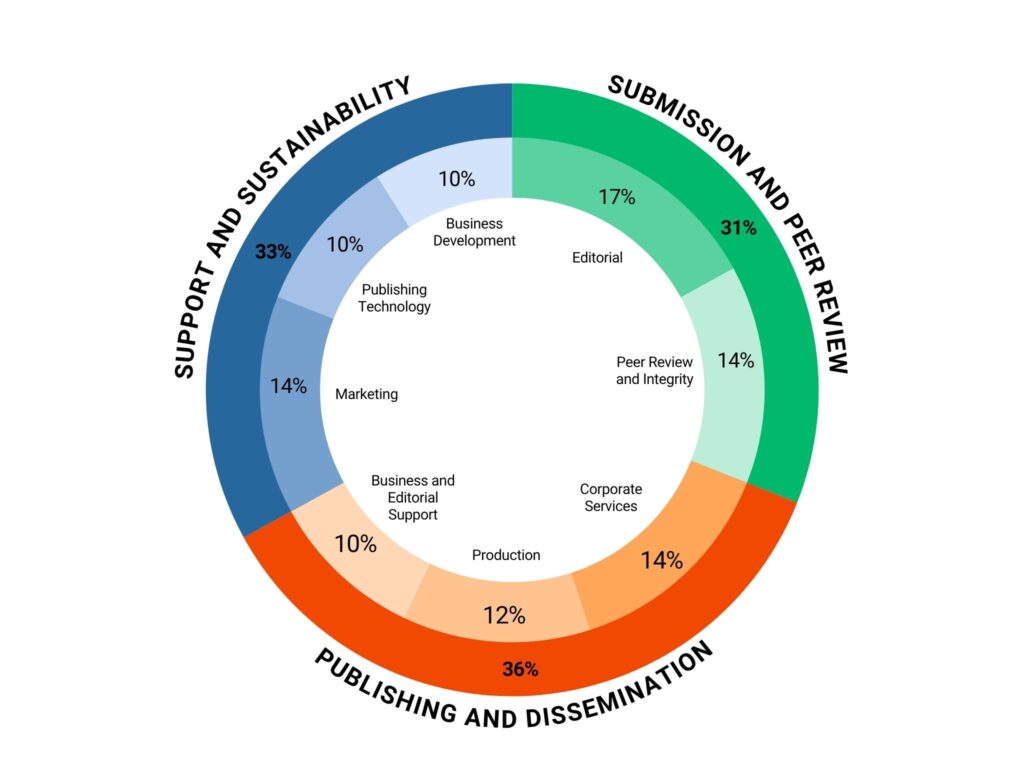
This figure shows the proportional cost breakdown of the different components of Canadian Science Publishing’s operations based on 2025 operating expenses. The outer ring indicates the general proportion of costs across three broad categories and the inner ring shows the specific cost allocations within each category.
Submission and Peer Review (31% of Costs)
CSP incurs costs which start with enabling authors to submit manuscripts to the journals. CSP employees check that the submission meets journal guidelines and help authors resolve issues before peer review begins. CSP provides the platform, tools, and support and our employees work with our editors and peer-reviewers to ensure this process runs smoothly. The CSP team provides hands-on support by organizing and monitoring the editorial and peer-review workflows to ensure the process happens in a timely, fair, and effective manner. Journal Editors are increasingly busy academics, therefore CSP’s paid employees need to handle as much of the administrative burden of editing a journal as possible. Many Editors and Editorial Boards find that it is not possible to run a scientific journal on a voluntary basis without this substantial support once the journal starts to receive a certain number of article submissions.
Behind the scenes, CSP employees conduct integrity checks. These include plagiarism detection, reference validation, and image screening to ensure data have not been manipulated. In some cases, manuscripts are returned to authors for clarification before they can proceed.
Meanwhile, CSP’s expert journal employees provide high-level direction for each of our journals. This includes working with Editors on developing journal strategy, appointing Editors and Editorial Boards, building the journal community by participating in meetings and conferences, and implementing initiatives to help the journals grow.
Publishing and Dissemination (36% of Costs)
Once an article is accepted, the focus shifts to turning it into a professional publication. Articles are copyedited for grammar, clarity, and consistency, making sure technical terms are precise and figures are labeled correctly. Articles are formatted for visual clarity to ensure they can be easily read and meet accessibility standards.
CSP’s production and technology team ensures the article connects seamlessly with indexing services like Web of Science, Scopus, and PubMed so it can be discovered and cited globally. Carefully tagged metadata supports discoverability through various platforms such as Google Scholar, ResearchGate, and library systems.
CSP’s marketing team works to increase article visibility through social media, newsletters, and press outreach. For example, a paper on Arctic ecology might be promoted to both the scientific community and news outlets covering climate change, helping the research reach the full range of potential readers.
Articles are also preserved in long-term archives to ensure that the research is a permanent part of the scholarly record. We make sure an article does not just exist, but is visible, accessible, and makes an impact.

Support and Sustainability (33% of Costs)
Like every publishing company, we need a reliable business infrastructure. Corporate services handle day-to-day operations like accounting and human resources. Our business development team negotiates with libraries to expand subscriptions and open access agreements, with the goal of reducing or removing APCs for authors.
Business support includes legal and insurance costs that protect everyone involved by ensuring copyright agreements are fair, authors’ rights are respected, and journals operate within Canadian and international regulations. Editorial support includes costs associated with our Editors, sponsorships, and governance structures that connect CSP journals with their scholarly communities, providing oversight and accountability.
This work may not always be visible, but it is essential. It’s what allows CSP to serve authors and readers for the long term. It ensures that the journals that researchers rely on today will still be here tomorrow.
Building a sustainable future for publishing
Scholarly publishing is so much more than simply making an article available online. It requires expertise and investment across every stage of the publishing process. At CSP, we reinvest every dollar into systems and people who uphold integrity, expand access to journals, and ensure that research remains discoverable, trusted, and permanent. We will continue to do what we do best so that the scientific discoveries of today become a lasting part of the scholarly record and benefit research communities for years to come.