
In the foothills of the Canadian shield, stands of sugar maples and yellow birch stretch towards the sky. Their roots thread through a thin soil, which has been slowly building to cover the barren bedrock exposed when the last of the ice sheets melted tens of thousands of years ago at the end of the ice age. Today, mosses and fungi cover fallen logs, turning decay into renewal. There are millions of species here, from the moose ambling between the ferns to the bacteria that cling invisibly to every surface.
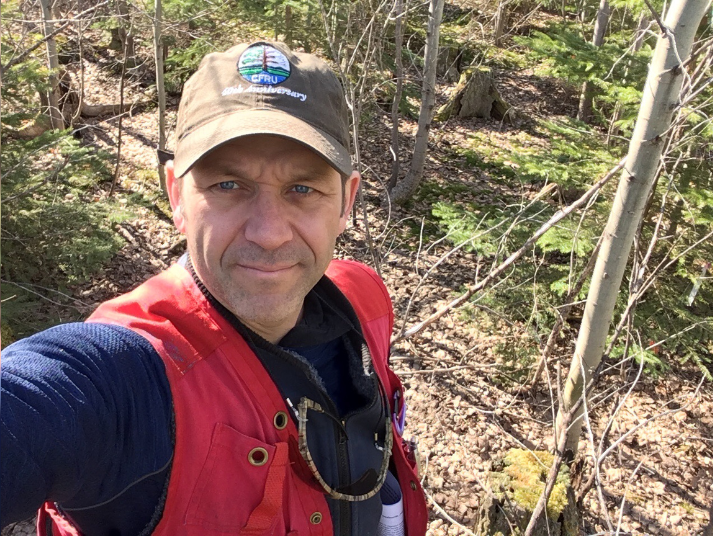
For Dr. Nelson Thiffault, a senior research scientist with the Canadian Forest Service of Natural Resources Canada, behind every dataset is a landscape like this, with species competing and cooperating, soils transforming, and disturbances reshaping interactions. For a researcher, that complexity comes with a paradox. How do you study ecosystems that operate on hundred-year timelines when most experiments last only three to five? Understanding the long-term forest processes that support resilience and climate change adaptation is essential for sustaining biodiversity, carbon storage, and the social values forests provide in a warming world.
In this conversation, Dr. Thiffault shares insights on what makes forest ecosystems so resilient, why humility matters in science, and takes us on a mountain bike ride through the woods. He also reflects on his career and how a single experience as an undergraduate student changed his trajectory, leading him all the way to his newest role as Co-Editor-in-Chief of the Canadian Journal of Forest Research.