
Rebecca Michaels-Walker

Rebecca Michaels-Walker is the Content Marketing Specialist at Canadian Science Publishing.

It takes a community to save a fish: A conversation with Dr. Trevor Pitcher

May 14, 2025 | 8 minute read

You can tell a lot about a scientist by how they answer a phone call. When we first connect with Dr. Trevor Pitcher, he’s in his car, excitedly offering updates between highway exits, en route from a policy meeting in Peterborough back to his lab in Windsor. It’s fitting of a researcher who never seems to sit still. As the driving force behind the Freshwater Restoration Ecology Centre (FREC), Pitcher juggles hatchery experiments, graduate student mentorship, and even video game design, all while ensuring local school kids can hand-release fish they’ve “adopted” into Ontario’s waterways. And now Pitcher has one more job to add to his list: he’s the new co-Editor-in-Chief of the Canadian Journal of Fisheries and Aquatic Sciences, and he has plenty of editorial ideas. 

But beneath his enthusiasm lies a pressing challenge: freshwater species are vanishing at an alarming rate. Take the redside dace, a small, silvery fish that leaps out of the water to catch insects. Victims of urbanization, pollution and habitat loss, redside dace populations have declined, putting them on Canada’s endangered species list. For years, efforts to save them stalled. “We didn’t even know their basic survival thresholds,” Pitcher explains. But now, his team are breeding the redside dace in captivity and deciphering their ideal habitat. Think of it as rewriting a missing instruction manual for a vanishing species—one that can guide restoration policies. It’s a breakthrough with big implications: if we can save one species, can we save others? 

But this work extends beyond tanks and data spreadsheets. At FREC, conservation isn’t just about science; it’s about rewriting who gets to participate in science. The centre has become a hub where researchers rub shoulders with policymakers, kids battle in a habitat-restoration video game (My Watershed), and First Nations communities collaborate on Indigenous-language children’s books. 

Ask Pitcher his proudest achievement, though, and he’ll list his students—future scientists, teachers, and advocates—who’ve turned “his” lab into “our” lab. There’s the team that revealed how to improve the fitness of captive breed fishes for conservation efforts and the team that turned fish spawning footage into a kids’ book franchise. The collaborators who prove that the best science is crowded with voices and maybe a little creative chaos.

So, what happens when science meets storytelling, policy, and play? We talk to Trevor Pitcher to find out.
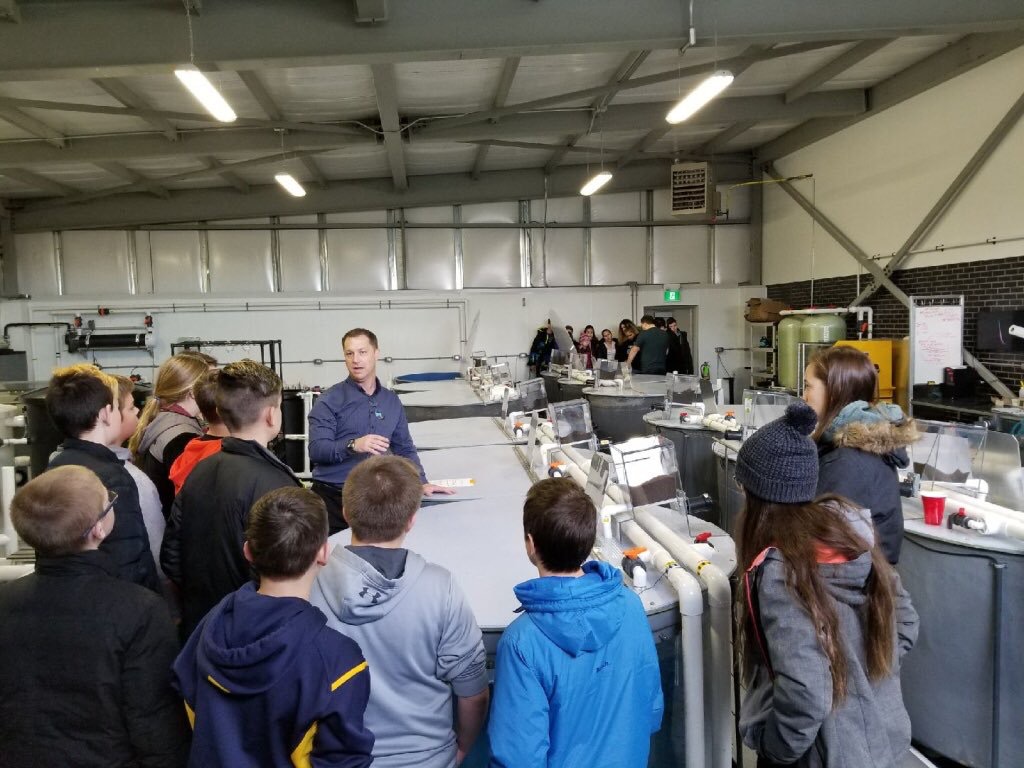
Dr. Pitcher talks to a group of students during a school visit at the Freshwater Restoration Ecology Centre.

Dr. Pitcher talks to students during a school visit at the Freshwater Restoration Ecology Centre.

You founded the Freshwater Restoration Ecology Centre at the University of Windsor. Is there a project you’re most proud of, or a recent success story you want to share?

I don’t want to sound cheesy, but the thing I’m most proud of is the graduates and postdocs who have come out of the lab we’ve built together. I always call it “our lab,” not “my lab,” because it’s truly a collaborative space. Seeing our alumni go on to diverse careers in fisheries and aquatic sciences—whether in environmental consulting, faculty positions, science outreach, or even teaching—will always be my number one achievement. 

If I had to pick a specific research project, I’d say I’m most proud of our work on redside dace. The redside dace is critically endangered in Canada, yet major research gaps had persisted for years. By establishing an experimental research population at the Freshwater Restoration Ecology Centre, we generated robust data to fill in those gaps and provide partners with a robust dataset for understanding and shaping policy.

We’ve been able to captively breed in preparation to reintroduce redside dace, study their environmental thresholds, and develop methods that weren’t possible for the past 15–20 years. It’s been a huge breakthrough—not just for us, but for the redside dace, too! 

Redside dace swimming in a large tank at the FREC.

FREC is helping to rebuild redside dace populations through research and captive breeding programs.

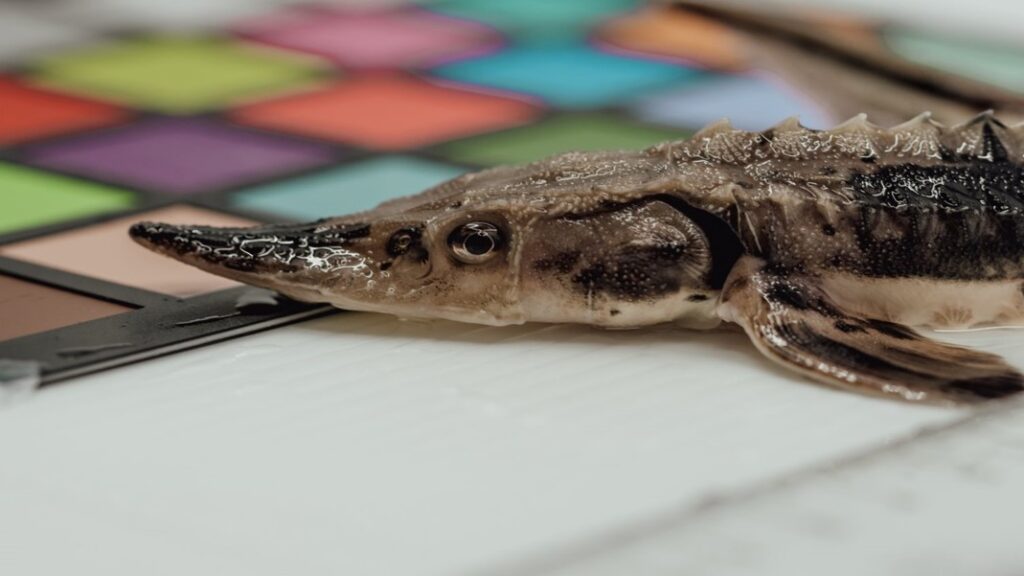
A lake sturgeon juvenile at FREC.

A lake sturgeon juvenile at FREC.

Your research integrates conservation, evolution, and reproductive ecology. What’s one surprising finding your team has uncovered recently?

One of our most unexpected discoveries—and this is very specific, but fascinating—is just how much female fish control which males win the fertilization game. It turns out that cryptic female mechanisms, like the influence of ovarian fluid, completely dominate fertilization outcomes. We were shocked to learn that something as subtle as ovarian fluid can completely dictate which male sires the offspring and this also has been shown to increase the fitness of the offspring produced 

It was incredible just how much control female fish (salmon and others) had over processes that nobody even understood. Researchers have been so ignorant of the female perspective. For years, research focused on male competition, but female agency—especially in species like salmon—was vastly underestimated and understudied. This gap was highlighted by my female grad students, such as Sarah Lehnert, who spearheaded this work. Their perspective revealed critical insights that reshape not just evolutionary biology, but also conservation practices (like breeding programs for endangered species). 

FACETS-Progress and Priorities for the Recovery of Aquatic Species at Risk in Canada
Read (or contribute to) FACETS’ new collection on the future of aquatic species recovery in Canada, guest-edited by Trevor Pitcher. EXPLORE

Between field research across Canada and advanced molecular techniques like eDNA and proteomics, your lab does it all. What’s the one research tool or method you’d take to a deserted island to study their local fish species, and why? 

That’s an interesting question that actually highlights something important about our lab’s approach. While some researchers are specialists who master one technique (which is incredibly valuable), we consider ourselves generalists. We collaborate with physiologists, geneticists, and other experts, so we’re fluent in multiple scientific “languages.” This interdisciplinary mindset has been key to our success, as our students and postdocs learn to bridge different fields. 

Now, if I were stranded on that beach? To be honest, I feel like all we’d need is a beach seine net and we’d get started! But if we could bring one fancier tool, I’d choose the sequencer. You can produce really solid science with just about any tool, but we really enjoy playing with that one! Plus, the sequencer would let us examine fascinating details like how offspring survive warmer and warmer waters—perfect for studying conservation biology in our island fish population. 

The Canadian Journal of Fisheries and Aquatic Sciences now accepts Methods papers.

If you could have a conversation with one of the species you study—like the redside dace or lake sturgeon—what would you ask them? 

I’d probably ask them if they hold any ill will for us as humans for ruining their environment! But in all seriousness, I’d ask them to describe their ideal habitat. With endangered species, one of our biggest challenges is understanding their exact habitat requirements. If I could speak to one, I’d ask them to describe their ideal habitat so we could better focus our restoration efforts.

The Pitcher Research Lab and the Freshwater Restoration Ecology Centre seem full of collaborators: students, mentees, and partners from across disciplines. In an ideal world, how do you envision collaboration between researchers, policymakers, and communities? 

For too long, science has been a top-down process. At our Centre, we’re flipping that model by creating a welcoming space for everyone, from schoolchildren to politicians, to engage with conservation. We host hundreds of visitors annually at our facility, which was designed to feel accessible to everyone. It’s also off-campus, which is important because universities can be intimidating. I grew up in a very blue-collar family; my dad was in construction and my mom was a nurse. Universities weren’t a part of our culture. They’re a very unintuitive space. So, the Freshwater Restoration Ecology Centre has a welcome room where we greet our visitors and make sure they feel comfortable.

To get back to your question, I think the answer is that we need to get rid of the top-down academic process and start working from the bottom up. We’ve done some really cool and successful projects, and they start with the community. My PhD student, Ashley Watt, was interested in writing a children’s book about our conservation work. We funded that project by selling some rare footage we’d taken of redside dace spawning to TVO for a documentary they were making about the species. Those proceeds funded the first book, and its sales funded the next. Ashley really drove this—we made it core to her PhD, not just some side project. Then there’s the video game we developed with Sheridan College, My Watershed, where teens compete to restore habitat. 

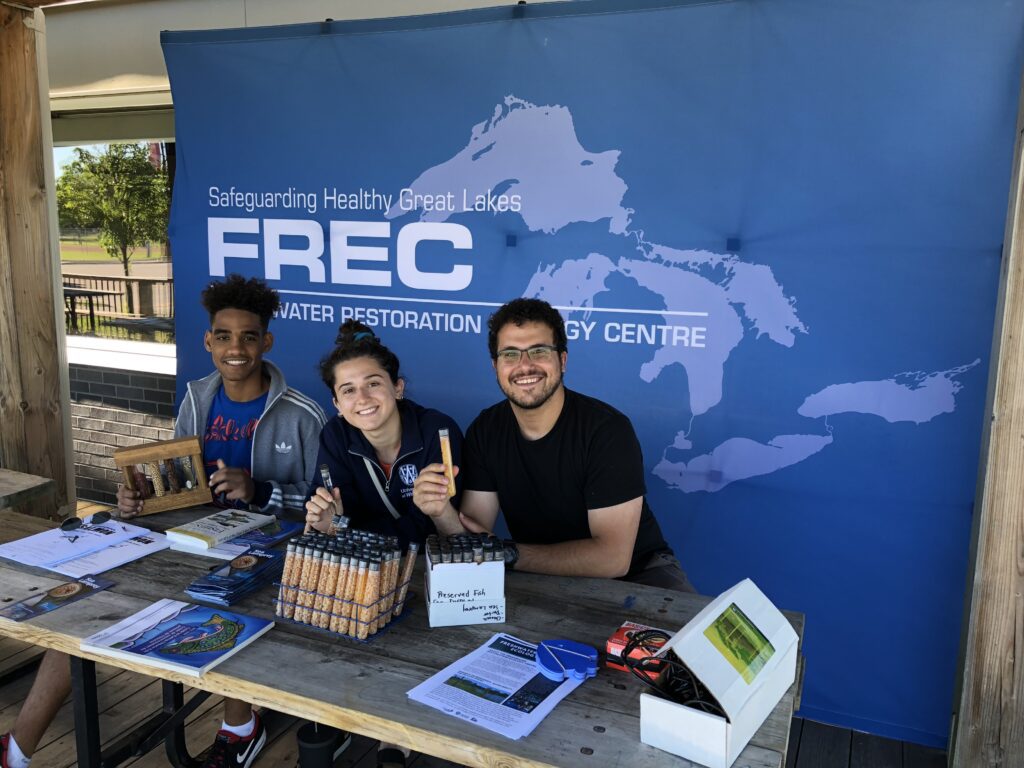
Three students sitting at a booth smile for the camera. They sit in front of a large sign with a picture of the Great Lakes.

Students promote freshwater research at an outreach event.

What’s been amazing is how these projects opened doors we never expected. When First Nations communities saw the physical books engaging kids with conservation stories, they immediately wanted to collaborate. The elders told us that seeing kids connect with traditional knowledge through books rather than screens was a game changer. 

I’ll be the first to admit this collaborative model didn’t come naturally. Making space for this kind of work is new, and at the beginning, I didn’t know what I was doing. It’s taken a long time to get here, but we’ve learned as we go. I still don’t know everything now—nobody does—but I do know how important this type of work is. I try to be super supportive of all my students because we’re all learning new things, including me.

Stevenson Lectureship Call for Nominations 2026
Honour an outstanding early-career aquatic researcher by nominating them for the Stevenson Lectureship Award. Winners receive a plenary lecture & journal feature! NOMINATE AN ECR

You’ve been involved with several journals, including the Canadian Journal of Fisheries and Aquatic Sciences and FACETS. What conditions/characteristics help a journal community thrive? 

The key to a thriving journal community comes down to staying connected with your readership. I’ve seen this firsthand through my work with several journals, including the Canadian Journal of Fisheries and Aquatic Sciences and FACETS. Early in my career, I witnessed what happens when publications become too top-down— they stop listening to their readership and lose touch with their community’s needs. It’s easy for large publishers to become disconnected, especially if they’re not associated with a society. 

One of the reasons I was so excited about this role was because of the Canadian Journal of Fisheries and Aquatic Sciences’ connections to the Society of Canadian Aquatic Sciences (SCAS). I think the best journals maintain two connections: first, to their historical roots (many foundational papers in our field came from these very journals), and second, to their current and future audience. At the Canadian Journal of Fisheries and Aquatic Sciences, for example, the editors actively sought community feedback, asking what types of papers were needed or what perspectives might be missing. Encouraging early career researchers to be part of the journal process, having workshops for new writers, and creating spaces where early career researchers can contribute without intimidation—these are things we never did historically. Many journals have failed in the past, and I think part of it is because they never did this kind of work. The magic happens when we all steer the ship. Being an editor in chief isn’t about dictating how things should work, but rather maintaining that productive back-and-forth that keeps a journal relevant to its community while honouring its legacy. 

It’s easy for large publishers to become disconnected, especially if they’re not associated with a society. The journal being a not-for-profit means it really feels like a team here. We’re working and learning together for the sake of the science.

As the new Editor-in-Chief of the Canadian Journal of Fisheries and Aquatic Sciences, what would you most like to implement to keep the journal at the forefront of aquatic science? 

I’m really excited to work with Marty [Krkošek], and I know we’ll collaborate on some great things. One of my goals is to reach out to our community of freshwater scientists more. While I’ll always value our strong foundation in marine biology and game fish research, I want to create more space for non-game species like redside dace and other imperilled freshwater organisms. Secondly, I’m actively working to diversify our content with different types of papers. This means reaching out to researchers personally when I see compelling work at conferences, particularly encouraging method-focused manuscripts that often go elsewhere.

The goal isn’t to shift focus, but to expand our scope—maintaining the journal’s esteemed reputation while ensuring it reflects the full breadth of aquatic science across Canada today. 

Image credit: All images used with permission, courtesy of Trevor Pitcher and the Freshwater Restoration Ecology Centre.

Rebecca Michaels-Walker

Rebecca Michaels-Walker is the Content Marketing Specialist at Canadian Science Publishing.