Michael R. Donaldson

Michael is the Director, Strategic Initiatives at Canadian Science Publishing.

Canadian Science Publishing’s Open Access Journey

October 21, 2025 | 5 minute read

At Canadian Science Publishing, our mission is to support researchers by publishing high-quality peer-reviewed journals that uphold scientific integrity, accessibility, and sustainability. As a not-for-profit publisher, we’re driven by a commitment to share scientific knowledge, not by profits. We fully support the principles of open access (OA) and recognize the many benefits it brings for authors, readers, and a multitude of stakeholders.  

Over the past 15 years, we’ve demonstrated our commitment to OA by providing authors with OA options in our journals, including four fully open access journals, with more launches on the horizon. Each year, we publish an increasing volume of open access content. We’re committed to a continued expansion of our OA pathways, yet we recognize there is no one-size-fits-all approach, especially in the current funding landscape.  

Below, we explain why CSP will continue to advance open access scholarly publishing by maintaining a mixed publishing model, which we believe is currently the most equitable and sustainable path forward. 

What is a mixed open access publishing model? 

A mixed open access publishing model combines multiple approaches to make research accessible while ensuring financial sustainability and equity for authors. In this model, some articles are published open access through article processing charges (APCs) in hybrid or fully open access journals, or transformative agreements, or subsidized (diamond) initiatives, while others are published in subscription journals supported by library and institutional subscriptions. Green OA options allow authors to share versions of their work in repositories, expanding access even for paywalled articles.  

This approach enables CSP to:  

  • Offer multiple publishing options for authors 
  • Increase the volume of open access content published each year 
  • Support authors who lack funding 
  • Maintain editorial independence 
  • Continue to explore and adopt new OA opportunities as stable, stand-alone funding becomes available 
Do you know the difference between green, gold, and bronze open access? Our comprehensive glossary breaks down key publishing terms, providing clear and concise definitions to help you navigate the world of open access. EXPLORE

OA shouldn’t be a barrier to publication 

Open access provides equitable access to reading content, however, there remain challenges with equitable access for authors to publish their content. Many authors, particularly those without funding, those in early-career stages, or those working in underfunded disciplines or institutions, may not be able to afford Article Processing Charges (APCs). We offer OA partnerships, waivers, discounts, and green OA options to help address these barriers. However, these measures still carry internal costs and do not fully offset the revenue required to operate high-quality journals. In fact, much of our open access publishing is currently made possible through revenue from our subscription journals. We carefully set subscription pricing to avoid double-dipping and maintain fairness for libraries and institutions. Our goal is to expand OA equitably, providing authors with more choice in how they publish. A mixed model allows us to support unfunded authors, while still growing OA. If more inclusive OA funding becomes available, we’re positioned to scale up our offerings. 

Financial sustainability 

Fully OA models require stable, ongoing financial support. Currently, there is no long-term, predictable source of funding that would allow us to convert all CSP journals to diamond OA, which is free to both authors and readers.  

Open access partnerships, such as Transformative Agreements (TAs), remain a key strategy but they come with challenges. These agreements are time consuming and challenging for libraries to negotiate with smaller publishers like CSP and not all authors benefit equally. Authors from smaller or underfunded institutions often do not have the same opportunities to benefit from TAs.  

Our ability to increase OA publishing depends directly on financial support, either through APCs, TAs, or external funding. While we are increasing our OA publishing volume annually, full OA will not be sustainable across our entire portfolio without consistent financial backing. We are actively seeking opportunities to support more OA publishing in ways that align with our values.

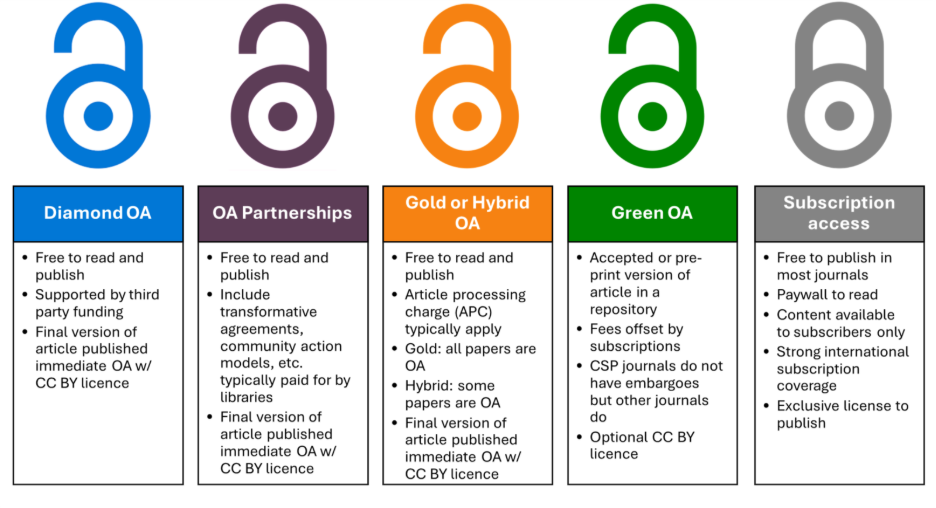
Figure 1. Different pathways to publishing show that there is no single model that meets the needs of all authors, institutions, and publishers. CSP’s mixed approach integrates these options to maximize access while ensuring sustainability and equity.

Independence: Risks of overreliance on external funders 

CSP is not only a not-for-profit publisher, we are also independent, meaning we do not receive any external grants to support our publishing operations. Diamond OA offers a promising future, but relying on third party funding from philanthropic or government sources can raise questions around editorial independence, particularly if funders have strategic priorities. Journals must remain impartial, independent stewards of the scholarly record. This requires funding models that are not vulnerable to political or commercial influence and that can operate long-term to ensure future viability of journals.  

We welcome OA funders and partnerships, but there are trade-offs if support is temporary or comes with strings attached. Expanding OA responsibly means ensuring that both editorial independence and journal longevity are protected. As more public-good funding mechanisms for OA mature, we are eager to participate, but we must tread carefully until those systems are stable. 

What about models like S2O? 

Subscribe-to-Open (S2O) is one of several emerging models, but it remains untested at scale and carries significant financial risk. For small publishers like CSP, the loss of even a fraction of subscribers could jeopardize the financial viability of entire journals. Once a subscription is canceled, libraries rarely re-subscribe. With content often accessible via interlibrary loan, preprints, green OA, or researcher sharing, the incentives to re-subscribe further diminish. 

While S2O and other models are promising, the financial risk is high without guarantees of uptake. For example, IWA Publishing noted a significant decline in subscription revenue after moving to S2O. Since the success of the S2O model is predicated on libraries maintaining subscriptions, IWA Publishing modified their S2O framework in 2024, such that institutions that do not participate in their S2O model will no longer be able to publish free of charge.  

We support experimentation, but the lack of scalable and sustainable funding sources for such models is a key constraint for CSP to transition our journals to full OA via S2O.

We partner with libraries, institutions, and consortia to provide more open access publishing options. Learn more about our open access agreements and whether you may be entitled to a reduction in fees.

A mixed model: CSP’s approach for now 

Our journals currently operate under a mix of funding models. This includes:  

  • APCs for hybrid OA and gold OA journals 
  • Subscription revenue  
  • Green OA options 
  • Exploration of new diamond OA opportunities (Figure 1)   

This diversified revenue model allows us to support and continue to increase the amount of research we publish as OA, provide a range of OA options to authors, maintain editorial independence, and ensure long-term viability of the journals and preservation of the research record. 

As illustrated by Figure 1, there are diverse models that support scholarly publishing, from fully subsidized Diamond OA to subscription-based publishing. Each pathway has unique strengths and challenges: APC-based gold and hybrid journals, transformative agreements and OA partnerships, author self-archiving through green OA, and subscription revenues that sustain journal operations. CSP combine these approaches in a mixed model. Our mixed model lets us grow OA year over year, while ensuring that all researchers, funded or not, can publish. It offers a flexible path forward while we work with the community to build more sustainable OA infrastructure. As more stand-alone funding emerges, we are ready and willing to adapt and hopefully accelerate our OA transition. This strategy allows us to serve the widest possible research community now, while actively planning for a more open future.

In partnership with the Canadian Research Knowledge Network, researchers at participating institutions can publish open access at no cost or at a discount.

Our commitment 

CSP remains committed to expanding open access pathways. We continue to explore sustainable approaches, including more transformative agreements, increased support for green OA, and funding for diamond publishing. At the same time, we recognize the need for balance: between access and equity, innovation and stability. Until a fully OA model becomes financially and operationally viable for all our journals, we believe a mixed model best serves the research community. We will continue expanding OA publishing every year, as we have been. 

We are proactively seeking new funding models and partnerships to support more OA. We welcome the opportunity for stakeholders to work with CSP on sustainable OA pathways.  

Our long-term goal is simple: to make as much research as possible open, sustainable, and equitable for everyone. 

Michael R. Donaldson

Michael is the Director, Strategic Initiatives at Canadian Science Publishing.