What sparked your interest in field crop entomology, and are there particular insect species that you are currently focusing on?
My interest came about with a project where I was looking at what species of cereal aphids were present in wheat fields and which beneficial insects were present and may be feeding on them. I realized that agriculture was a great place to be doing entomology, and I stuck around!
Bugs in the North’s papers include a range of study sites and a variety of crops and insect species. What management strategies do we see arising in this research?
One common thread was between three papers that dealt with management strategies using pheromone attractants and, in one case, floral attractants (van Herk et al. 2024, van Herk et al. 2025a, van Herk et al. 2025b). Pheromones are chemicals signals used by various species to attract adults who are looking to mate, and so you can use pheromones in a mass trapping strategy—meaning that you catch so many that you can depopulate the mating population.
But first, you have to test how those pheromones work. In these studies, they seem to be doing a good job of capturing the insects that they were supposed to.
How are the pheromones manufactured and tested?
First, you need an entomologist to figure out the problem. For instance, can those insects be attracted by a pheromone lure? Wim Van Herk has been working on click beetles for a few years, and they realised that not all the beetles were using pheromone attraction for mating. One of the species was actually all female, so there were no males to react to a pheromone;therefore a pheromone won’t work for that species.
You identify the system, and then, if it’s a female-produced sex pheromone, you need to catch enough females to either extract the pheromone from the pheromone gland or encourage them to start pheromone calling and then trap the chemicals that are coming off. The entomologist then gives way to the chemical ecologists who determine what the pheromone components are and whether they elicit an antennal reaction. The chemical ecologist tries to synthesize those compounds, and at this point, the entomologist or the behavioural ecologist gather a bunch of males and introduce those chemicals to see if the males are attracted to them. If you find a blend or compound that works in the lab, then you can take it out in the field.
In Bugs in the North, we mainly see papers in the last stage—testing it out in the field.
What findings from the collection would you recommend sharing with producers (i.e., farmers and agronomists)?
If you are a producer and you want to manage insects, your questions would be: what are these insects and what could be in my crop?
All papers in the collection deal with economically important insect species, but in different crop production systems. Some deal with tracking the population spread of various pest insects. One addresses gaps in economic impact estimates in field crop production (Srivastava et al. 2025), while others provide baseline descriptions of pests and new crops in northern regions (Chennamkulangara et al. 2025, LaForest and Mori 2025, Lefebvre et al. 2025, Wijerathna et al. 2025). The collection covers everything from blueberries to corn production to pulses and alfalfa (Aguiar-Cordero and Prager 2025, Gervais et al. 2025, Shi et al. 2025).
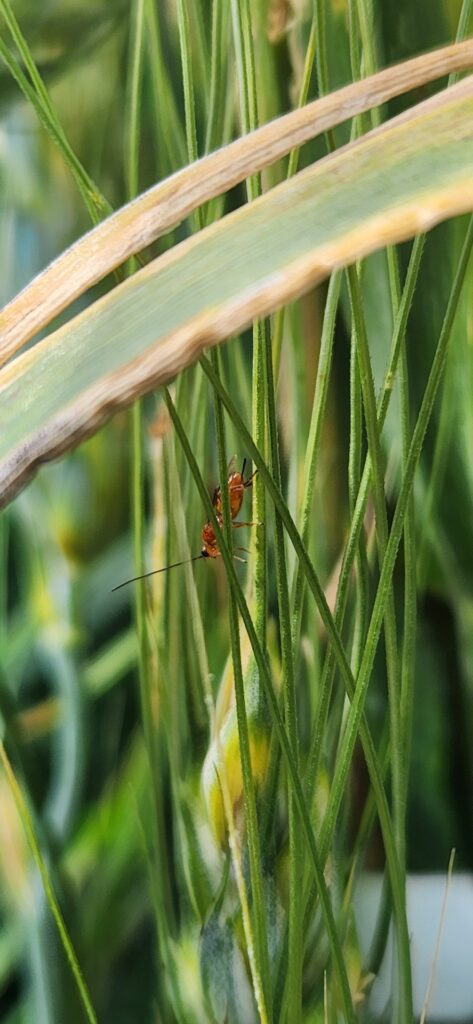
Bracon cephi (wheat stem sawfly parasitoid). Credit: Tyler Wist
Some of the key information from these papers would give farmers a new pheromone tool to attract those click beetles (the adult stage of wire worms) (van Herk et al. 2025b). Researchers were also looking to determine the level of resistance to insecticides by Colorado potato beetle, which is the worst pest in potatoes (Ménard et al. 2025). For farmers, if you lose a chemical tool for controlling a pest, then you need to know that before you go out and spray.
Evaluating kaolin clay as a pest management tool against flea beetles was interesting, as that could potentially be used in more of an organic market. I don’t think kaolin clay falls under your typical insecticide category (Rajan and Cutler 2025).
In their paper, Beres’s team (2025) suggests a method to enhance the biocontrol of wheat stem sawfly by leaving wheat straw as tall as possible if you’re in a wheat stem sawfly area, because that preserves the overwintering habitat of the Braconid wasp, Bracon cephi, a species that helps to suppress wheat stem sawfly populations and which pupates up in the wheat stem. That’s one practical way to help your local biocontrol agents.