
Canadian Science Publishing

Led by a team of dedicated researchers, Canadian Science Publishing is an independent, not-for-profit publisher committed to enhancing the reach, rigour, and relevance of science so that people can find, trust, and use it.

A Year of Growth at Canadian Science Publishing

December 16, 2025 | 5 minute read

In 2025, Canadian Science Publishing achieved substantial growth and progress. The teamwork, enthusiasm, and dedication of our journal editors, peer reviewers, society partners, and employees resulted in a very successful and rewarding year.

Expanding Our Community

Canadian Science Publishing brings together a broad community involved in creating and supporting research including editors, reviewers, authors, readers, institutional libraries, and societies. This year, we worked to grow our community, investing time and care into expanding editorial boards, improving publishing processes, and supporting authors.

The commitment to building our community showed up in many ways. David Castle became Chair of our Board of Directors, succeeding Paul Young, and we were pleased to welcome Amy Buckland and Shawna Sandler to the Board. Amy’s work in advancing Open Scholarship and Library Publishing, along with Shawna’s leadership in research infrastructures and global partnerships, brings new voices and fresh perspectives to our Board.

Beyond strengthening our not-for-profit governance, we also focused on expanding our journals’ editorial boards. In total, we appointed 167 new editors, which is a 70% increase from last year. This included 15 new Editors-in-Chief, two Founding Editors, and two Deputy Editors.

We welcomed our first cohorts of Early Career Researcher Associate Editors to the Canadian Journal of Earth Sciences, Botany, and Canadian Journal of Zoology. This provides mentorship opportunities and hands-on editorial experience for Early Career Researchers.

More than 10,000 authors chose to publish their work in our journals and we saw a 25% increase in accepted articles in 2025. To better support our authors, we updated our author guidelines related to ethics and reporting for human and animal studies. We also simplified our license signature requirements to make the submission process easier for authors.
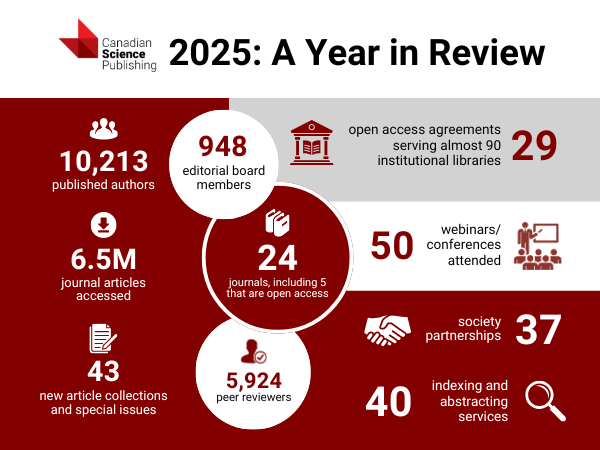
Infographic titled “Canadian Science Publishing - 2025: A Year in Review.” It highlights key metrics: 10,213 published authors; 948 editorial board members; 5,924 peer reviewers; 6.5 million journal articles accessed; 43 new article collections and special issues; 24 journals, including 5 that are open access; 29 open access agreements serving almost 90 institutional libraries; 50 webinars and conferences attended; 37 society partnerships; and 40 indexing and abstracting services.

We attended more than 50 conferences, webinars, and events, providing:

  • Meet-the-editor sessions
  • Author workshops
  • Peer review and publishing guidance
  • Outreach for early-career researchers
  • Opportunities for researchers to learn more about our journals

Some of these events are available online including our “Maintaining trust in published scientific research” webinar, which was presented with the Canadian Science Policy Centre. These events helped us connect directly with researchers and strengthened our 37 society partnerships. We were pleased to renew and form new partnerships with societies including the:

To support research which provides evidence for policymakers, we launched Publishing Canada’s Policy Future, a collection of journal articles assembled in collaboration with the University of Toronto Press, Coalition Publica, and Érudit.

Our social media presence expanded in the spring, with all journals now on Bluesky and several joining LinkedIn, giving us more opportunities to share the important research being published in our journals.

Beyond these in-person and virtual connections, “Your research has a home here” is the message we shared far and wide, encouraging researchers to publish their research in Canada. At a time when academic freedom is being challenged, we want researchers to know that we continue to prioritize what matters most: fairness, inclusion, and the freedom to publish without boundaries.

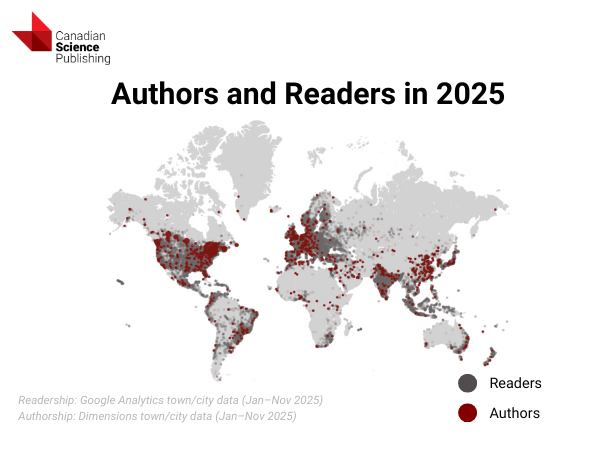
A world map titled "Authors and Readers in 2025" shows the global distribution of Canadian Science Publishing authors (red dots) and readers (grey dots), illustrating international reach in 2025.

Journal Growth and Development

In 2025, we expanded our journal portfolio and launched a new journal, Contaminants, Environment, and Society, which officially opened for submissions in the fall. We also welcomed the Journal of Psychiatry and Neuroscience to Canadian Science Publishing. Both these open access journals create new opportunities for researchers to share high-quality, impactful work.

Several of our journals reached important milestones in 2025. Arctic Science celebrated its 10th year of publication. FACETS expanded its vision and scope to include interdisciplinary work that integrates the social sciences. The Canadian Journal of Plant Science expanded its scope beyond continental climate agriculture to invite research from all geographical regions of the world, and the Canadian Journal of Physiology and Pharmacology expanded to seven additional areas of research including cardiovascular, cell biology, clinical trials and case reports, metabolism, neuroscience, organ systems, and translational pharmacology.

To diversify the types of research published, we introduced new article types: Data Papers and Method Papers for Canadian Journal of Forest Research, Methods for Canadian Journal of Fisheries and Aquatic Sciences, and Perspectives for Applied Physiology, Nutrition, and Metabolism, Canadian Journal of Plant ScienceArctic Science, Canadian Journal of Physiology and Pharmacology, Canadian Journal of Microbiology, and Canadian Journal of Zoology.

Our partnership with Dryad, a nonprofit repository for data, expanded to include the Canadian Journal of Forest Research and Contaminants, Environment, and Society, allowing authors to archive the data underlying their articles for free. We continued to develop peer review, introducing Double-anonymous peer review for Drone Systems and Applications and Contaminants, Environment, and Society to enhance fairness and reduce bias in the review process. In addition, the Early‑Career Reviewer Program with the Society of Canadian Aquatic Sciences provided early‑career researchers with peer review experience and training. We also formed a new reviewer board for the Canadian Journal of Animal Science.

Expanding Access to Scientific Research

In the fall, we shared an update on our open access strategy and why we will maintain a mixed publishing model, which we believe is currently the most equitable and sustainable path forward.

We announced several new read and publish agreements and we’re proud to share that we now have 29 open access agreements serving about 90 institutions. These agreements lower barriers to publishing open access by offering researchers low or no cost publishing options. These library agreements also allow researchers who are affiliated with the universities to have read access to our subscription journals. For researchers, this means equitable access to high-quality publishing.

Looking Ahead

It has been a year of growth, new ideas, and meaningful progress. We are grateful to everyone who shared their time and expertise. As an independent not-for-profit publisher, we depend on this support to operate our journals and continue to share research. We are proud of the progress we made in 2025. Building this year’s success, we look forward to 2026 as an opportunity to continue advancing science by publishing high-quality research, strengthening our journals, and supporting the research community.

Canadian Science Publishing

Led by a team of dedicated researchers, Canadian Science Publishing is an independent, not-for-profit publisher committed to enhancing the reach, rigour, and relevance of science so that people can find, trust, and use it.