Rebecca Michaels-Walker

Rebecca Michaels-Walker is the Content Marketing Specialist at Canadian Science Publishing.

Fieldwork at the frontlines of climate change: Dr. Isabel C. Barrio on Arctic research

February 17, 2026 | 6 minute read

For Arctic field biologists, life involves a lot of planning. Months ahead of each field season, there are permits and grants to secure, equipment to order, travel to coordinate, and late-night calls with team members across time zones. Then there are supplies to pack: gear, clothes, water bottles and rolls of duct tape, sharpies and schedules, notes and passports, perhaps a chocolate bar or extra socks. Everything is constrained by a simple reality: it all needs to fit into a backpack, and nothing can be forgotten. In remote areas, there’s no going back for a toothbrush when you’re a week-long boat trip from the nearest town. When the journey finally begins, the stresses of preparation melt away.

Dr. Isabel C. Barrio knows this world well. A professor in the Faculty of Environmental and Forest Sciences at the Agricultural University of Iceland, she studies how plants and herbivores interact in tundra ecosystems. These dynamics shape food webs and landscapes, and play a critical role in how arctic ecosystems respond to climate change. What might look like insignificant interactions can have outsized effects, especially in a region that’s changing rapidly.

Dr. Barrio leads two international research networks, and is the newest Co-Editor-in-Chief of Arctic Science. She is driven by discovery and a sense of adventure. In this interview, we discuss her favourite moments from the field, what it really means to be a researcher, and what it’s like to meet an elephant seal face-to-face.
You’re involved in two major, interconnected research networks: the Herbivory Network and the Nordic Borealization Network. Can you give an overview of these projects and explain how they complement each other?  

These two networks grew out of similar motivations: understanding how northern ecosystems function and how they respond to rapid environmental change, and doing so through collaboration with researchers asking similar questions. In both cases, the aim was to create a platform that brings people together and facilitates collective work. 

The Herbivory Network connects researchers across the circumpolar north who study how herbivores, from small invertebrates to large mammals such as reindeer and muskoxen, shape tundra vegetation. It is a global, bottom-up initiative where members share data, protocols, and ideas to better understand how herbivore impacts are changing in a warming climate. The network began in 2014 and was endorsed as a UArctic Thematic Network in 2020. 

The Nordic Borealization Network (NordBorN) is a more recent initiative that emerged through a NordForsk funding opportunity supporting university cooperation across the Nordic countries. This support has been essential for launching the network. Its core idea is similar to that of the Herbivory Network: to provide a meeting point for researchers and strengthen collaboration. NordBorN focuses on a closely related ecological process – how boreal species are moving northward and upslope as the climate warms. This “borealization” can influence everything from carbon balance to wildlife habitat, and of course will have consequences to local livelihoods. The network creates a space for researchers, especially early-career scientists, to coordinate monitoring, compare results, and collectively consider the broader implications of tundra borealization. 

In many ways, the two initiatives complement each other by building connections among researchers. They also address closely linked ecological processes: herbivores and vegetation change are deeply intertwined – herbivores can accelerate or slow borealization, while the arrival of new plant and animal species from the boreal forest can reshape food webs. Working within both networks has allowed me to bring these perspectives together and better understand how Arctic ecosystems are changing.

You’ve worked in some of the world’s most remote and ecologically sensitive areas, from Nunavut to the Subantarctic Islands. Is there a particular landscape or moment in the field that left a lasting impression on you? 

There have been so many! And that’s the magic of fieldwork. Yes, there are long days, heavy backpacks, and the occasional unexpected challenge, but there are also those moments that stay with you for years, the ones that capture the wonder of the natural world. 

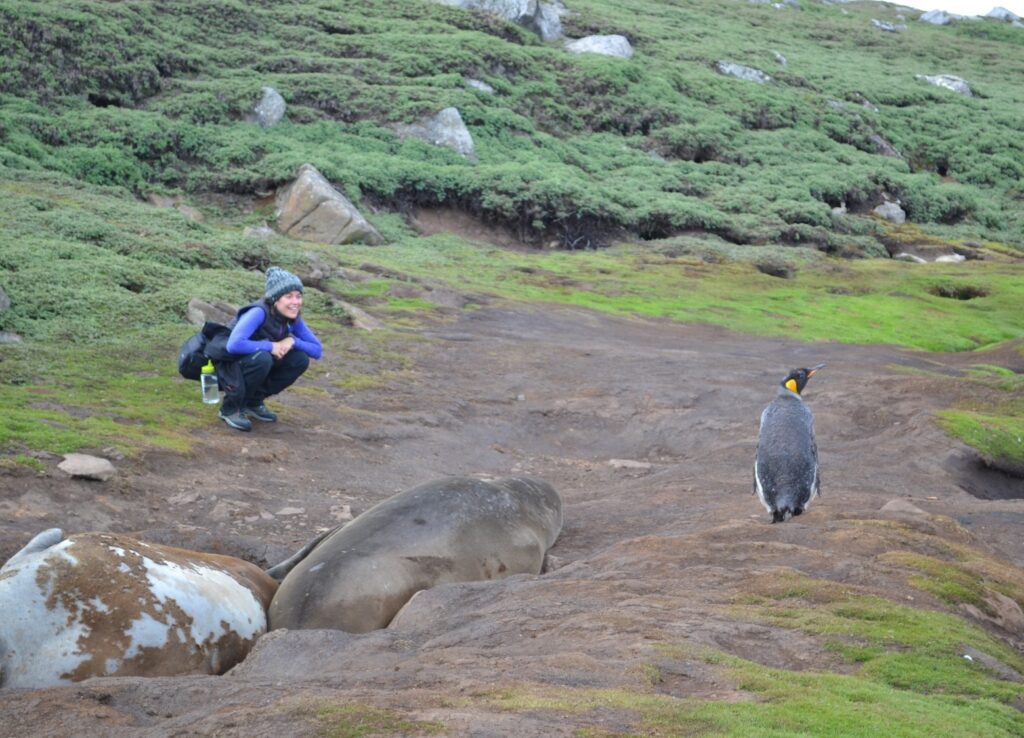
One of my most memorable and “exotic” field seasons was the chance to work on the subantarctic Kerguelen Islands in the South Indian Ocean with the French Polar Institute (IPEV). Getting there was an adventure in itself: sailing for more than a week from Réunion Island, watching the world shift from warm tropical waters to cold, windswept subpolar seas. By the time we arrived, it genuinely felt like stepping onto another planet. 

Kerguelen is one of the most remote places I’ve ever visited, and one of the most fascinating. As a biologist, it was a mind-blowing experience to rethink how an entire ecosystem works. Terrestrial food webs there are dominated by decomposers rather than herbivores (apart from the introduced rabbits, which seem to be everywhere), and the influence of the ocean shapes everything. Seabirds and seals are constant companions; the boundary between land and sea feels almost blurred. 

I’ll never forget the first time I came face-to-face with an elephant seal – an encounter that would repeat itself many times, because they are truly everywhere. Moments like that, when you’re learning an entirely new environment and trying to understand how all its pieces fit together, are what keep me excited about ecological research. It’s that feeling of discovery, of seeing how differently ecosystems can function, that continues to motivate me.

If we joined you on a typical day in the field, what might we find in your backpack?  

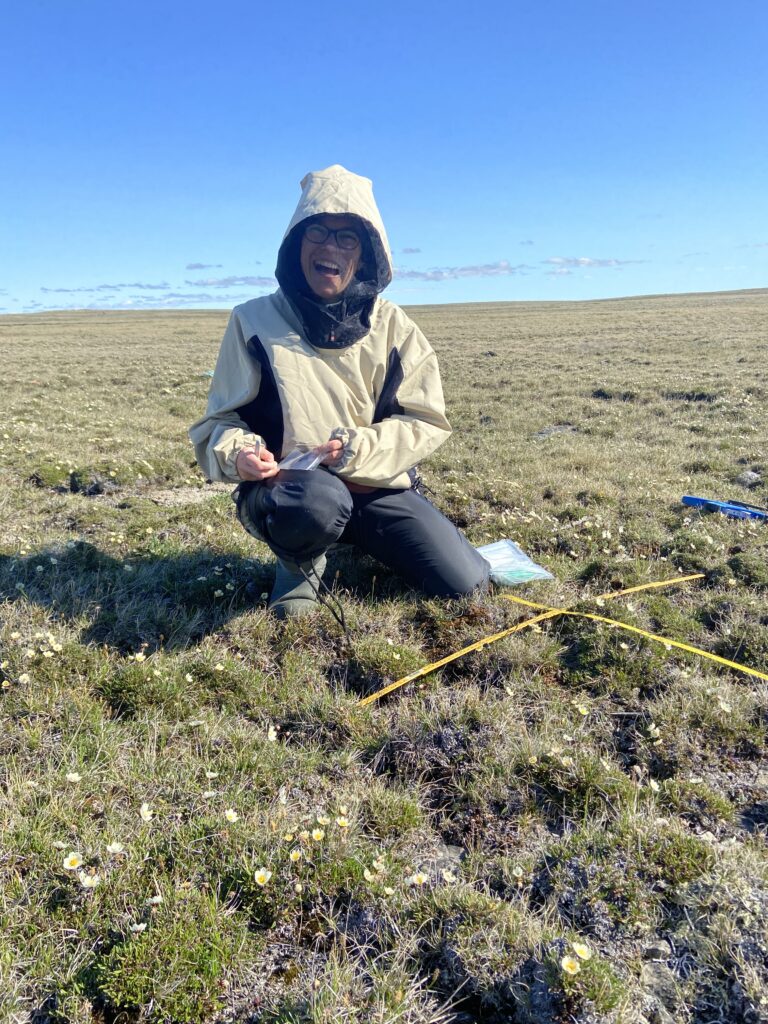
Aside from chocolate (which is absolutely essential) I carry the usual fieldwork staples: tape measures, flagging tape, sharpies (each tied with flagging tape because tundra vegetation has a mysterious ability to swallow them!), duct tape, and plenty of plastic and paper bags to collect samples. Depending on the project, there might also be a point intercept frame, a magnifying glass or a soil moisture probe. And then, of course, the practical gear: weatherproof layers, warm gloves, extra socks, sunscreen, and lots of water. My backpack is always bigger than I think it needs to be, but somehow it’s always full! 

Many of your projects involve international collaboration. What have you found most rewarding and most challenging about working across borders and disciplines?  

The most rewarding part is without question the people. Arctic and alpine research is incredibly collaborative by nature – none of us can do this work alone, and every project benefits from the knowledge, creativity, and cultural perspectives of colleagues around the world. Working across borders also helps us see patterns and processes that would not be visible if we worked in a single place. 

The challenges are often practical matters: coordinating across time zones, navigating different funding structures, dealing with the unavoidable delays of Arctic logistics or the complicated geopolitical situation. But those challenges are usually outweighed by the excitement of building something together. In the end, international collaboration makes the science more robust and also helps you feel part of a strong, supportive community.

Coordinating research across Arctic and alpine ecosystems must be complex. What are some of the biggest logistical or scientific challenges you face?  

Coordinating research can be complex, but I’ve found the Arctic research community to be exceptionally welcoming and collaborative. We all work in remote environments and deal with similar challenges – unpredictable weather, short field seasons, ever changing plans – so there’s often a shared sense of problem-solving and mutual support. 
Scientifically, one challenge is making sure that our data are comparable across sites. The ecosystems are diverse, and small differences in methods can really matter. That’s why coordinated protocols, data sharing and good communication are so important. When we get those right, we gain an incredible ability to compare patterns across vast regions.

Many of your projects involve long-term ecological monitoring. What does a typical field season look like for you, from planning to data collection? 

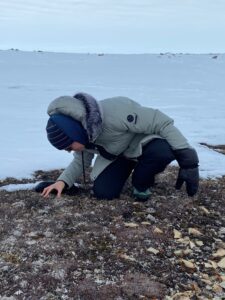
It actually varies a lot from year to year. Some seasons are just about maintaining the long-term monitoring sites, making sure that plots are well marked and that the equipment is working properly. We regularly collect data on plant communities and other environmental data, or we repeat measurements that have been taken for a decade or more. Other field seasons are dedicated to experiments or specific add-on projects, where timing becomes more important. For example, if we’re studying flowering or seasonal changes in carbon fluxes, we might visit sites multiple times to capture those changes. 

Planning usually begins months in advance: coordinating travel, recruiting field assistants, securing permits, and watching weather and snowmelt patterns. Once we’re in the field, the pace is intense but rewarding. Days are long, often too long because you lose track under the midnight sun, and consist of hiking between plots, collecting samples, and figuring out the logistics for the next day.

Uncover three decades of Arctic change and emerging Earth observations in high‑Arctic Svalbard, spanning atmosphere to ocean and everything in between. EXPLORE

Is there a piece of advice (scientific or personal) that you come back to often? 

“What is your research question?” It’s the piece of advice I give my students constantly, and a reminder I often need myself. It’s so easy to get excited by data, patterns, or new methods and ideas, but grounding everything in a clearly articulated research question keeps the work focused and meaningful. My students joke that it’s my mantra — but I think it’s a very useful one! 

As co-Editor-in-Chief of Arctic Science, how do you see the journal’s role evolving in a world increasingly shaped by climate urgency and biodiversity loss?  

I think Arctic Science has an important role to play in a time when climate change and biodiversity loss are reshaping northern ecosystems at an unprecedented pace. In this context, Arctic Science should continue to be a flexible, inclusive venue where the community brings together diverse types of knowledge, from long-term ecological monitoring to Indigenous Knowledge systems, modelling studies, and interdisciplinary approaches. 

Scientific publishing is changing as well, and I hope Arctic Science can lead by example: embracing new forms of authorship, supporting early-career researchers, encouraging open data and transparency, and being responsive to how science is actually done today. My goal is for Arctic Science to remain a place where northern researchers feel at home, supported, and inspired to share their best work. 

Photo credit: All photos courtesy of Isabel C. Barrio.

Rebecca Michaels-Walker

Rebecca Michaels-Walker is the Content Marketing Specialist at Canadian Science Publishing.