
Rebecca Michaels-Walker

Rebecca Michaels-Walker is the Content Marketing Specialist at Canadian Science Publishing.

The future of farming: A conversation with Dr. Youbin Zheng

December 1, 2025 | 5 minute read

When you picture farming, you might imagine open fields and bright blue skies, not LED lights and climate-controlled rooms. But for Dr. Youbin Zheng, the new Editor-in-Chief of the Canadian Journal of Plant Science, the future of agriculture is indoors. A full professor at the University of Guelph and former president of the Canadian Society for Horticultural Science, Dr. Zheng has spent more than 25 years pushing the boundaries of controlled-environment agriculture (CEA), from greenhouse vegetables to cannabis. Recognized internationally for his expertise, his research shapes real-world practices, helping growers produce high-quality crops year-round while reducing environmental impact. 

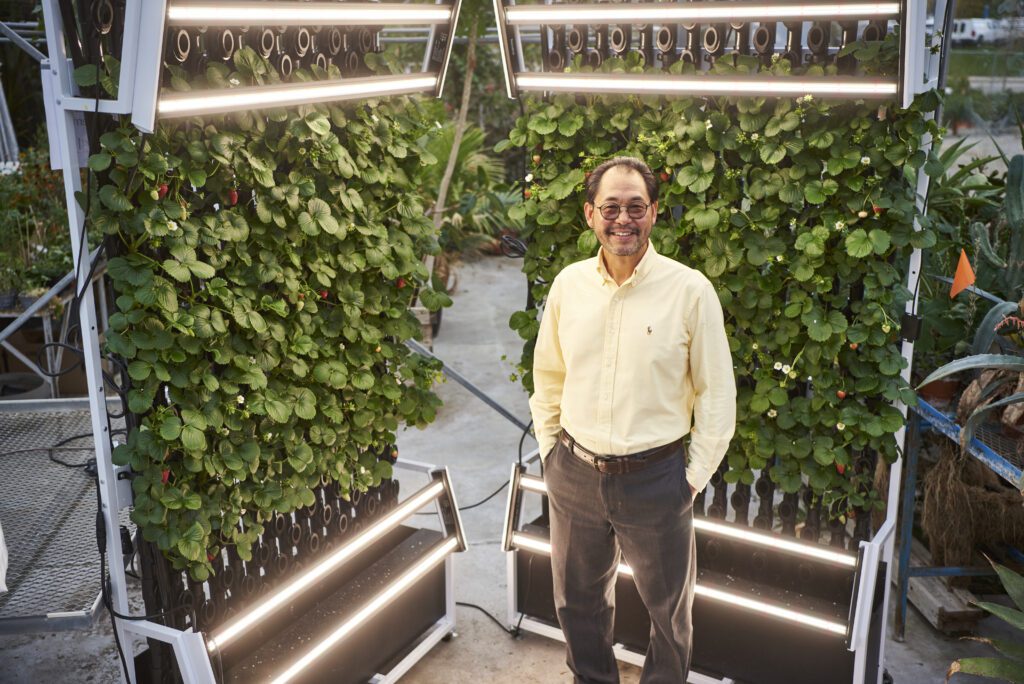
Dr. Zheng is a scientist who thrives on solving practical problems. How do you produce fresh vegetables in the dead of a Canadian winter? How do you ensure cannabis grown for medical use is safe, consistent, and sustainable? His answers have led to breakthroughs in plant lighting, rootzone management, and even the use of AI to optimize production. In this interview, Dr. Zheng shares what sparked his passion for controlled environments, the myths he’s debunked in cannabis science, and how local CEA food production could make people and the planet healthier.Dr. Zheng stands in front of a vertical wall of strawberry plants lit by LED lights.
What sparked your interest in growing plants under artificial conditions like vertical farming or LED lighting? 

Due to population increases and urbanization, Canada’s arable land has been shrinking, and people are increasingly centralized in large cities such as the Greater Toronto Area. Providing locally grown fresh vegetables, medicinal plants, and berries to urban residents is not only good for the environment but also essential for people’s health. Controlled environment agriculture (CEA) mainly produces plants soillessly, eliminating the need for fertile soil, and can be established within or near cities. Pandemics and geopolitical tensions can also complicate the import of fresh produce from other parts of the world to Canada. Climate change can cause extreme weather (e.g., sudden killing frost in the spring, drought, or storms during the growing season), making field production of certain crops difficult. CEA uses both natural light and LED lighting, which allows growers to produce plants year-round. Resources can be reused to increase production efficiency and reduce environmental pollution. For example, nutrient solution can be reused, saving water and fertilizer and limiting agriculture’s negative impact on the environment. 

In your studies on cannabis, you’ve looked at everything from rooting techniques to optimal light levels. What about cannabis makes it such an important subject of research? 

Cannabis has been used as medicine for many years and it impacts peoples’ lives in different ways. It is important to cultivate this plant based on scientific principles to achieve the desired yield and consistent quality. CEA cannabis production can ensure that cannabis maintains the same quality from batch to batch, which is essential when it is used as medicine. Additionally, since cannabis was illegal for a long time, there are many myths and a lot of misinformation about how to grow this plant. Scientific research is important to guide growers in cultivating this plant effectively and efficiently, minimizing the waste of resources and money and limiting environmental damage. 

The Canadian Journal of Plant Science has a new, expanded scope. LEARN MORE.

What’s something the public (or even fellow researchers) often misunderstands about cannabis science? 

As mentioned previously, there is a lot of misinformation in the cannabis world. For example, it was widely believed that producing cannabis flowers needs high phosphate (P) concentration in nutrient solutions. Our research demonstrated that many commercial cannabis cultivations have been using too high a P concentration in their nutrient solutions. Excess P use not only can reduce yield, but also wastes valuable resources and can damage the environment. 

It was also believed that most high THC (delta-9-tetrahydrocannabinol) cannabis cultivars required a 12-hour uninterrupted dark period to flower; however, our research demonstrated that many cultivars can flower under shorter dark periods, allowing a longer photoperiod. This discovery enables growers to provide more than 12 hours of light per day to cannabis plants, which can lead to increased yield and improved quality. 

Cannabis is a tightly regulated and scientifically scrutinized crops. What challenges has this presented in your research? 

Yes, regulations require that research be conducted in a secure location and that all materials are tracked. Fortunately, we have industry collaborators with secure facilities where we can conduct our research. This is also beneficial for technology transfer because our collaborators can use our research results right away in their cannabis production operations. Our university is very supportive of our research, and we have recently secured some facilities that can be used to conduct cannabis-related research and training on campus. 

Looking across your research career, is there a discovery or project that you’re particularly proud of—something that surprised you, challenged you, or changed your path? 

Many of our research results have been used in the green industry, including greenhouse plant production and green roof installation. For example, in the past, if someone needed to install a green roof, they had to order their plants about one year in advance to give the growers enough time to produce them. Our research has developed technologies can produce installation-ready plants in about 4-6 weeks.  

As another example, basil can’t be stored in a place lower than 10ºC, otherwise the leaves can be damaged and develop black spots. Our research found that by applying silicon-containing compounds during cultivation, harvested basil plants can be stored at low temperatures for more than two weeks. This discovery is important for basil producers and retailers worldwide. 

Most of my research is conducted in collaboration with my research associates and students. The rewards for me are not only that the results can be used by the horticulture industry, but also that the talented students trained in my program end up finding good careers and contributing to society. 

Celebrate the recipients of the 2024 Canadian Journal of Plant Science Awards

If you had unlimited funding for one research project, what would it be? 

I’d continue to develop science and technologies to produce high-quality and high-yield plant materials in controlled environments efficiently and sustainably year-round. 

You’ve worked on projects from global air pollution assessments to LED spectrum tuning in microgreens. How do you balance those scales in your research? 

When I was younger, I studied how plants respond to air pollutants, such as ozone, CO2, etc. These studies were conducted in controlled environments (e.g., growth chambers). I learned a lot about plant physiology and biochemistry, especially stress physiology and how to use controlled environments for growing plants for research. More than 25 years ago, I started to apply all the knowledge and technologies I learned in controlled environment plant production research, mainly on rootzone management (e.g., soilless growing media, fertigation) and lighting management (e.g., the use of different spectra, light intensities and photoperiods). In terms of plants, I worked with many types of high-value plants, such as ornamentals, microgreens, baby greens, bitter melon, strawberries, and cannabis. When it comes to plant cultivation, all the knowledge and technologies are interconnected, and many can be used in various situations; therefore, it is not difficult to maintain balance.  

Much of your work focuses on sustainability. What’s one innovation in sustainable agriculture that gives you real hope for the future? 

There are many factors and I can be biased! Canada’s winters are dark and cold, so, for half the year, hardly any produce can be grown and supplied locally. Fresh produce is best grown locally and consumed promptly for optimal nutritional value and to reduce transportation’s carbon footprint. Using CEA to grow fresh produce locally and sustainably is crucial for food security and human health. Developing technologies to improve CEA’s efficiency and save resources such energy, labour, water, and nutrients while providing fresh, nutrient-rich produce locally needs to be prioritized faster, especially as we face challenges like climate change. 

Rebecca Michaels-Walker

Rebecca Michaels-Walker is the Content Marketing Specialist at Canadian Science Publishing.