Contributors:

Dr. Ivan Arismendi, Dr. Kathleen Church, Felix Eissenhauer, Dr. Catherine Febria, Jaime Grimm, Robert Masaki Hechler, Bradley Howell, Dr. Andrea Kirkwood, Jessica Reid, Dr. Christina Semeniuk, and Kendra Thompson-Kumar.

Equity for early-career researchers in fisheries and aquatic science

September 26, 2025 | 9 minute read

Scientific societies unite themed communities of researchers and professionals. These societies often host conferences (including in-person, virtual, and hybrid formats), which provide a critical platform for idea exchange, networking, outreach, engagement, and mentorship, especially for early-career professionals. Yet, participating in conferencing opportunities can be inaccessible to early-career professionals due to imposed barriers, which may lead to disadvantages for career development. From representation within a society’s membership to affordability, health, or social limitations, there are many areas of growth for scientific societies within Canada to increase equity and inclusion for the benefit of all.

Inspired by diversity and inclusion work done at the American Fisheries Society, a similar conversation within the Canadian aquatic sciences community has been brought to the main stage in recent years. In 2019, Dr. Christina Semeniuk, Associate Professor at the University of Windsor, presented “Inclusion and Diversity in Canadian Fisheries and Aquatic Sciences: A Time to Reflect” at the 2019 Canadian Conference for Fisheries Research (CCFFR). This led to the formation of the Justice, Equity, Diversity, Inclusion, Accessibility and Indigeneity Committeewithin the society and helped to normalize conference workshops and sessions on themes of equity, diversity, and accessibility in subsequent years.

In 2022, a networking workshop entitled “Diversity in Networking: Creating Opportunities For All” was held at the final CCFFR-Society of Canadian Limnologists (now known as the Society of Canadian Aquatic Sciences) joint conference to build inclusive networking practices and discuss a shared vision for the society. The lessons learned about the role scientific societies play in providing inclusive networking and mentorship opportunities were published in the Canadian Journal of Fisheries and Aquatic Sciences by a diverse team of workshop attendees and organizers. Today, members of the article’s author team reflect on the progress made and the work still to be done in an interview below:
Read “On increasing equity and inclusion of early-career professionals for conferences and conference networking in Canadian fisheries and aquatic science societies” in the Canadian Journal of Fisheries and Aquatic Sciences.

Could you tell us a bit about your perspective on the state of diversity and inclusion in fisheries and aquatic sciences in North America right now?

Historically, the fields of fisheries and aquatic sciences have been predominantly composed of white men. Today, these research areas are much more diverse, though there’s still a lot of work to be done to promote Justice, Equity, Decolonization, Indigenization, and Inclusion (JEDII). Some institutions and societies doing this work are:

Despite these efforts, significant challenges remain. Systemic biases, limited access to mentorship, and a lack of representation continue to hinder progress.

Ultimately, the fields of fisheries and aquatic sciences we see today are primarily made up of colonial institutions. Colonial fisheries management practices have disrupted and criminalized Indigenous fishery systems across Canada. There’s a growing recognition that sustainable fisheries can’t exist without environmental and social justice, and with this increased recognition, there has been a slow collective movement towards achieving those goals.

The limited progress in DEI (Diversity, Equity, and Inclusion) in the U.S. over the past two decades is now at risk under the current Trump administration. Issues related to DEI in fisheries and aquatic sciences will be more pronounced in the next few years. However, when Canadian DEI efforts are considered in contrast to those in the U.S., Canada has the opportunity to highlight the strengths of prioritizing DEI and to emerge as a global leader in DEI for fisheries and aquatic sciences.

Ready to grow as a reviewer? Sign up for the Early-Career Reviewer Program and start shaping the research that drives Canada’s aquatic science community. LEARN MORE

Your paper offers a list of practical strategies to remove barriers to both in-person and online events. What metrics should societies adopt to evaluate the success of their inclusivity efforts?

Societies should make the effort to maintain demographic data and administer attendee satisfaction surveys from annual meetings to evaluate the success of their efforts, as these data are essential for tracking progress and driving change.

Additionally, the creation of working groups/committees where members can routinely offer suggestions, feedback, and introduce new ideas to the society can lead to proactive, bottom-up change.

Some barriers to participation, like affordability or physical accessibility, are more commonly addressed, while others, like health limitations or parental responsibilities, are often overlooked. Why do you think this imbalance exists?

Affordability and physical accessibility are more tangible and widely recognized barriers, and they’re “easier” to address through funding, infrastructure changes, or policy adjustments. However, barriers like health limitations or caregiver responsibilities are often individualized, requiring tailored solutions that may not fit within standard accessibility frameworks.

Additionally, historical precedent likely plays a role, as caregiving barriers are generally higher for women compared to men who have dominated aquatic science in the past.

You mention that early-career professionals (ECPs) may struggle with “unspoken rules of academia.” Can you share some examples of these norms?

The process of graduate school and other aspects of academia (such as tenure or publishing) can be a black box for students and early-career researchers. This may be the result of a lack of public resources or inadequate mentorship from their supervisors. Unspoken rules of academia can be found throughout one’s journey, from beginning the application process and how to approach potential supervisors to securing a graduate committee in one’s first year.

Because of invisible norms (i.e., often what is perceived as “socially acceptable” by a [white] majority that does not account for differences in culture, neurodiversity, and training), it’s easy to feel excluded from opportunities or to feel that you’re “not good enough” for academia. In reality, the failure lies with institutions and academic culture for not providing adequate resources and mentorship to support talented students and early-career researchers successfully.

Ready to publish but don’t know where to start? This free webinar offers advice from writing and submission to peer review and open access. Discover what editors look for and learn how to avoid common pitfalls. GET STARTED

Were there any barriers to inclusivity that initially seemed minor but were revealed to have a profound impact during the workshop?

One example that may not register as a barrier to inclusivity until you have attended your first academic conference is the time limits for presentations. The scheduling and structure of many academic conferences can force presenters to conform to practices that hinder creativity, storytelling, and sharing the full depth of one’s research. Tight scheduling can leave attendees hungry and exhausted, limiting opportunities to network and build relationships.

What can those of us with ECPs in our lives (supervisors, mentors, friends, family) do to best support them?

Currently, science is under attack in the U.S. and has been undervalued in Canada for a long time. Many researchers have to juggle justifying their existence alongside conducting their research. If you have a loved one involved in academia or research, consider becoming an advocate for causes that give breathing room back to researchers. It does not take a background in science or an intricate understanding of a loved one’s research question to sign petitions that push for improving federal funding for science, to pay attention to and act on local issues that impact the cost of living, or to support the queer community against the attack on trans folks. Offering compassion and support in these areas can help to improve conditions for researchers to get back to doing what they love.

Also, offering food and emotional support goes a long way! Research can be stressful, so any way you can enable your ECP to relax and enjoy life outside of their research definitely helps.

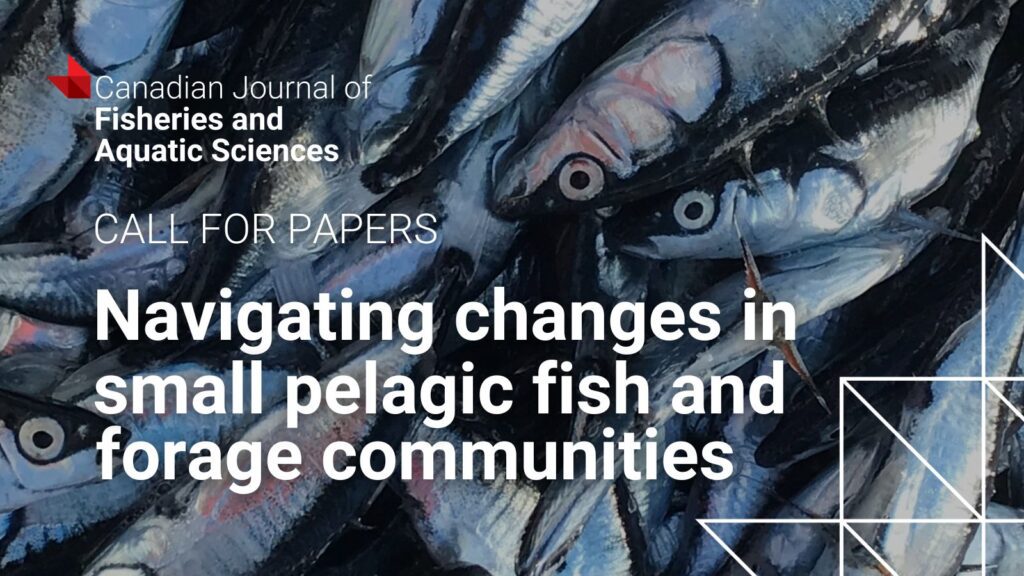
Small pelagic fish make up more than 30% of the global fisheries catch. A new collection explores their role in food webs, ecosystems, and sustainable management. LEARN MORE

Have any recent conferences or events positively impacted your experience in fisheries and aquatic sciences, particularly regarding equity and inclusion?

The most recent Society of Canadian Aquatic Sciences (SCAS) conferences have all included a significant number of Indigenous speakers and participants, as well as Indigenous knowledges. This inclusion demonstrates a collective movement in Canada towards two-eyed seeing (i.e., the bringing together of Indigenous and scientific knowledge for the benefit of all) in fisheries and aquatic sciences. It has been an extremely positive experience to be a small part of this movement.

You may be interested in…
“Equity in action: a 4-year journey towards gender parity and racial diversity in biochemistry hiring”

How are you and your team continuing to advocate for equity and inclusion in aquatic sciences? Do you have any other projects or papers in the works?

Actively recruiting students from underrepresented backgrounds and providing paid research opportunities ensures that financial constraints don’t exclude talented individuals. We maintain flexible work arrangements for those with caregiving responsibilities or health limitations, and we pair early-career students with senior graduate students to create peer-support networks within the lab. Lastly, we set clear expectations for inclusive and respectful communication in lab meetings and fieldwork settings (Dr. Ivan Arismendi, Oregon State University).

I believe that actively seeking and considering the perspectives of Indigenous Rights-holders is extremely important. It is also crucial to accurately identify these perspectives rather than assuming them. To this end, I have recently submitted a manuscript that identifies the perspectives of the Cree of Eeyou Istchee regarding fish habitat compensation projects (Dr. Kathleen Church, Missouri State University).

As early-career researchers, we try to approach equity and inclusion in aquatic sciences both through everyday practices and longer-term career choices. For us, this means fostering relationships with colleagues who are committed to equity and inclusion and making JEDII efforts part of our job search—for example, by paying attention to the initiatives that potential labs or employers have in place. We also try to raise awareness through small but visible actions, such as displaying pride stickers on office doors or including pronouns on conference name tags, which can help signal support and allyship. In addition, many of us participate in EDIA workshops or events, incorporate diverse perspectives into our science communication, and think about accessibility in our field and lab work (Felix Eissenhauer, Carleton University).

In addition to the points above, showing through example that all of these actions demonstrate how harnessing diversity is a strength in science teams and generates more impactful science. Our team blends early-career researchers who are students or postdocs, but also Indigenous youth, farmers, and others who hold perspectives that are critical for research and capacity strengthening on the ground. Knowledge co-production, partnership, and co-development generate better outcomes for science and society. In the context of our science lab, restored and nourished relationships are crucial for ecosystems, species-at-risk, and a more sustainable future (Catherine Febria, University of Windsor).

At the 2025 SCAS conference, FishCAST instituted the very first mentoring workshop at SCAS, “Learning to Navigate the Waters Together: Fostering Mentorship and Networking at Every Career Stage.” SCAS members signed up to be mentors and mentees, and a series of activities were held (following a distributed survey) on the following topics: how to network, mapping career pathways, applying for jobs, and navigating imposter syndrome. The workshop was incredibly successful, and we had the full support and participation of SCAS Board members who wish to see this workshop continued.

About the authors

Dr. Ivan Arismendi is an Associate Professor at Oregon State University studying the consequences of climate change on freshwater ecosystems.

Dr. Kathleen Church was a Post-doctoral Fellow at the Université du Québec en Outaouais who studied the effectiveness of fish habitat compensation efforts and is now an Assistant Professor of animal ecology at Missouri State University.

Felix Eissenhauer is a PhD candidate at the University of New Brunswick and incoming Post-doctoral Fellow at Carleton University, studying the effects of hydropower dams on fish ecology.

Dr. Catherine Febria is an Associate Professor at the University of Windsor investigating ecosystem-based and partnership-led approaches to habitat restoration and aquatic species-at-risk management.

Jaime Grimm is a PhD candidate at the University of Toronto and incoming faculty at the University of Victoria examining policy and management solutions to wild fish conservation in coastal British Columbia.

Robert Masaki Hechler is a PhD candidate at the University of Toronto studying drivers of aquatic biodiversity dynamics and resilience under global change.

Bradley Howell is a PhD candidate at Trent University examining how metabolism and behaviour shape predator-prey interactions in freshwater fishes.

Dr. Andrea Kirkwood is a Professor at Ontario Tech University investigating the impacts of human activities on aquatic ecosystems.

Jessica Reid completed a Master’s of Biology in fish ecology at Carleton University and is now the Editor Engagement Coordinator at Canadian Science Publishing.

Dr. Christina Semeniuk is the Director of FishCAST and an Associate Professor at the University of Windsor studying the effects of human disturbance on (usually) aquatic organisms.

Kendra Thompson-Kumar the Program Coordinator of FishCAST and an Administrative Assistant at the University of Windsor.

Contributors:

Dr. Ivan Arismendi, Dr. Kathleen Church, Felix Eissenhauer, Dr. Catherine Febria, Jaime Grimm, Robert Masaki Hechler, Bradley Howell, Dr. Andrea Kirkwood, Jessica Reid, Dr. Christina Semeniuk, and Kendra Thompson-Kumar.