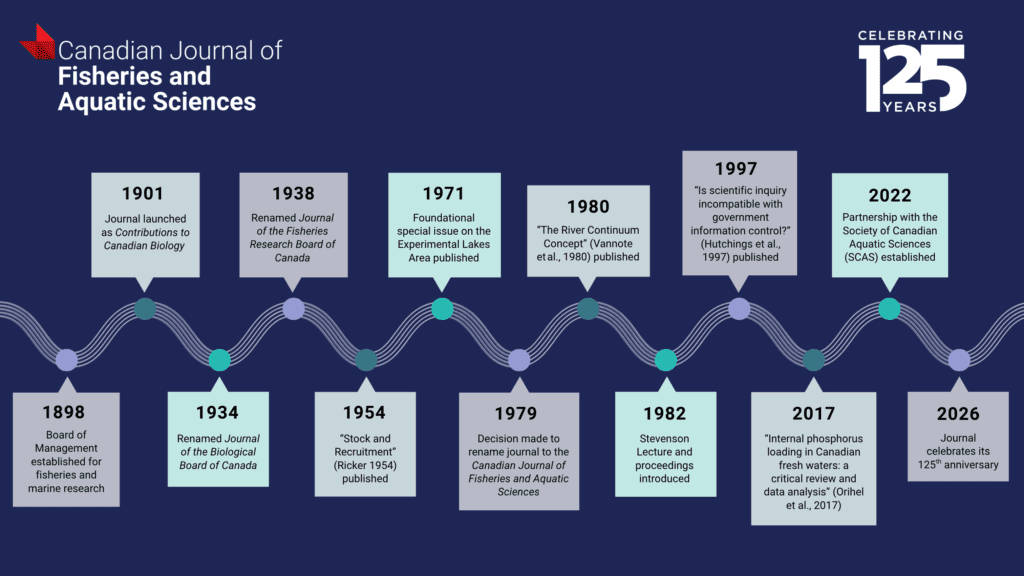
In 2026, the Canadian Journal of Fisheries and Aquatic Sciences (CJFAS) celebrates its 125th anniversary, marking over a century of contributions to the multidisciplinary field of aquatic sciences. From its origins as a local government initiative into an internationally respected journal, this post explores the key milestones and influential papers that have defined the journal’s history.
125 Years of the Canadian Journal of Fisheries and Aquatic Sciences
1898
The journal’s origins began at the turn of the 20th century, when the Canadian government initiated a new kind of research governance model: government research would be supervised by knowledgeable individuals from outside the public service. In 1898, a Board of Management was established to oversee fisheries and marine research and to create and manage a biological station on the Atlantic coast. As its responsibilities expanded, the board was formalized by an Act of Parliament as the Biological Research Board of Canada in 1912. Over time, its role continued to grow, leading to its renaming as the Biological Board of Canada, and eventually, in 1937, it became the Fisheries Research Board of Canada.
1901
The journal was launched by Edward Prince as Contributions to Canadian Biology. It was originally “a venue for publication of the novel findings of the [biological] station’s summer investigators.” Prince served as the first Editor-in-Chief until 1921. He was also the inaugural director of the station, known today as the St. Andrews Biological Station.
1926
The journal was renamed to Contributions to Canadian Biology and Fisheries.
1934
The journal was renamed the Journal of the Biological Board of Canada.
1938
Only four years after its previous name change, the publication was renamed the Journal of the Fisheries Research Board of Canada. This title would remain for four decades, during which the journal published some of its most foundational works.
1954
“Stock and Recruitment” by William Ricker was published. This paper introduced the Ricker Curve, a mathematical model that describes how the size of a parent population influences the number of new offspring in the next generation. It remains a fundamental tool for understanding fish population dynamics.
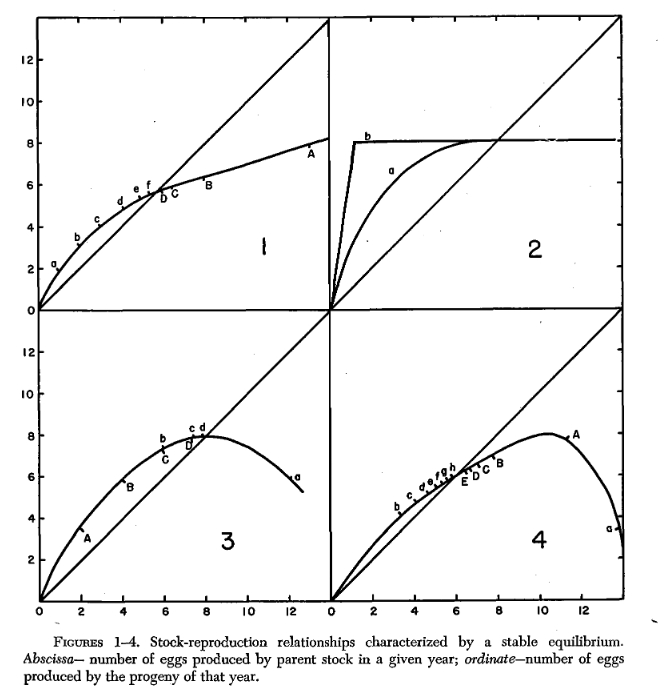 Examples of Ricker’s “reproduction curves,” later called Ricker curves in his honour.
 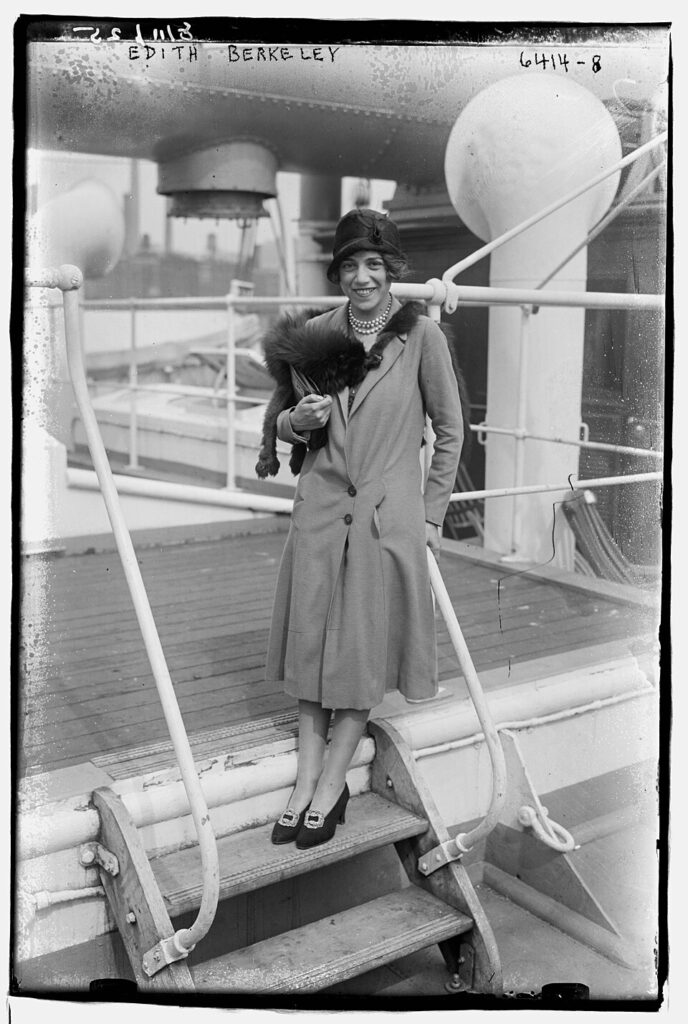 Edith Berkely. Source: Library of Congress Catalogue.
1971
The journal dedicated a special issue to Edith Berkeley, a world expert on marine polychaetes, and her husband Cyril Berkeley, a chemist. Both were founding teachers at the University of British Columbia prior to their 40 years of research as volunteer investigators for the Board’s biological station on the Pacific coast, known today as the Pacific Biological Station. Edith led the publication of eight papers in the journal throughout their career.
1971
The journal published a seminal special issue that provided the background data and rationale for the Experimental Lakes Area (ELA). This initiative was designed to study the effects of eutrophication. Pioneering whole-ecosystem research conducted at the ELA would go on to be published in four dedicated special issues in the journal.
1974
The Societas Internationalis Limnolociae (International Association of Limnology) hosts its first meeting in Canada, in Winnipeg, Manitoba. The journal is selected to publish the customary report that, at the time, preceded the meeting and provided the host country’s contributions to limnological research, for which Canada had many ranging from eutrophication studies at the ELA to linking physical and chemical properties of lakes to their productivity.
1979
The journal adopted its current name, the Canadian Journal of Fisheries and Aquatic Sciences. Acting Editor Jordan Watson noted at the time that while the name changed, the policy remained the same: to “to encourage publication of the best manuscripts in fisheries and aquatic sciences” by providing “first class service in scientific editing, peer review, and publication production.” The journal’s name and policy remain the same.
Explore the latest issue of the Canadian Journal of Fisheries and Aquatic Sciences.
1980
“The River Continuum Concept” by Robin Vannote et al., one of the most influential ecological frameworks ever, is published. It revolutionized the scientific understanding of stream ecology and watershed management. The “Concept” was revisited in the journal 40 years later solidifying its enduring influence.
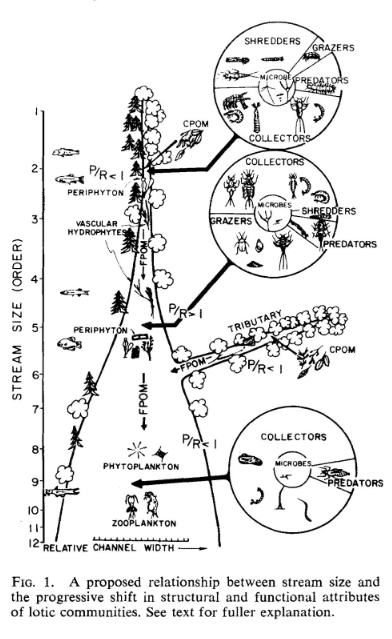 Figure 1. from Vannote et al., 1980, illustrating how stream size affects the structure and function of ecological communities.
1982
The Stevenson Lecture and its accompanying proceedings were introduced, named after former Editor J. Cameron Stevenson. The first award was presented to Daniel Ware for his research on the evolutionary fitness of teleosts. The Lectureship continues to recognize the creativity and impact of early-career researchers in fisheries and aquatic sciences. in fisheries and aquatic sciences.
1983
In 1983, during an era of increasing specialization in science, the journal’s leadership explicitly refined and reaffirmed its scope as a generalist journal. This decision ensured that the journal would remain a home for multidisciplinary research. would remain a home for multidisciplinary research.
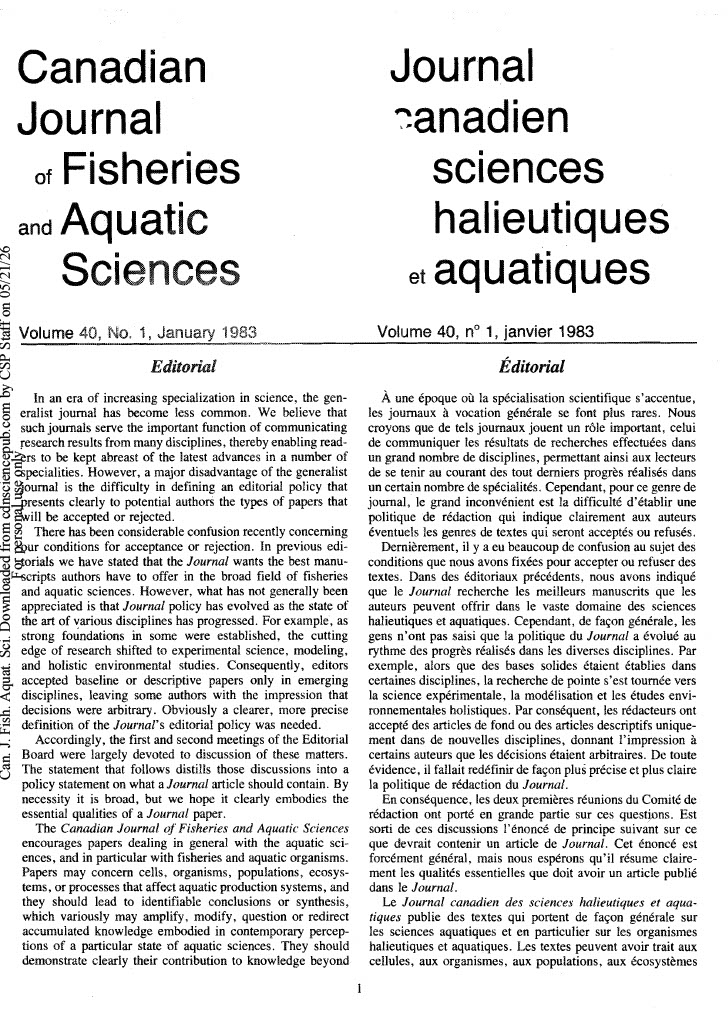 The first page of the 1983 editorial in which J. Watson, Editor-in-Chief, and Hohanna M. Reinhart, Editor, confirmed CJFAS’ generalist scope.
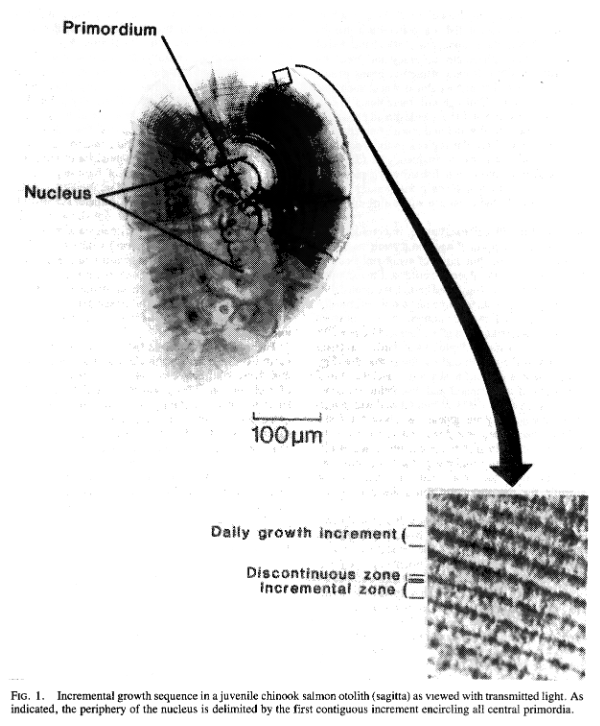 Figure 1. from Campana and Neilson, 1985.
1985
Steven Campana and John Neilson’s paper on the “Microstructure of fish otoliths” became a global cornerstone for fisheries science. It standardized the interpretation of otoliths, allowing researchers to accurately reconstruct the age and growth history of fish.
1993
A major administrative shift occurred in 1993, when editing responsibilities for the journal passed from the Department of Fisheries and Oceans to the National Research Council of Canada. This move marked the beginning of a transition from government-led publishing to an academic model.
1996
The journal embraced the digital age in by making the publication available in an electronic format. By 1997, the editorial office began moving toward the electronic transmission of manuscripts between authors, reviewers, and editors.
1997
Jeff Hutchings et al. published a highly controversial and consequential paper titled, “Is scientific inquiry incompatible with government information control?” The authors argued that bureaucratic and political interference could compromise the integrity of government-administered science. An editorial in the issue addressed the controvery and potential pushback from the decision to “expose dirty Canadian laundry to an international audience.” Twenty-five years later, Hutchings’s question was revisited in the journal.
1999
The journal published a practical statistical toolkit for fisheries stock assessment with Ransom Myers et al.’s paper on the “Maximum reproductive rate of fish at low population sizes.” Their findings provided a previously unavailable and empirically grounded approach to managing vulnerable fish populations. managing vulnerable fish populations.
2001
The year 2001 marked a full century of publication for the journal. To celebrate the 100th anniversary, Editors John Roff and Moira Ferguson reflected on the journal’s evolution from its early federal roots to its modern standing.
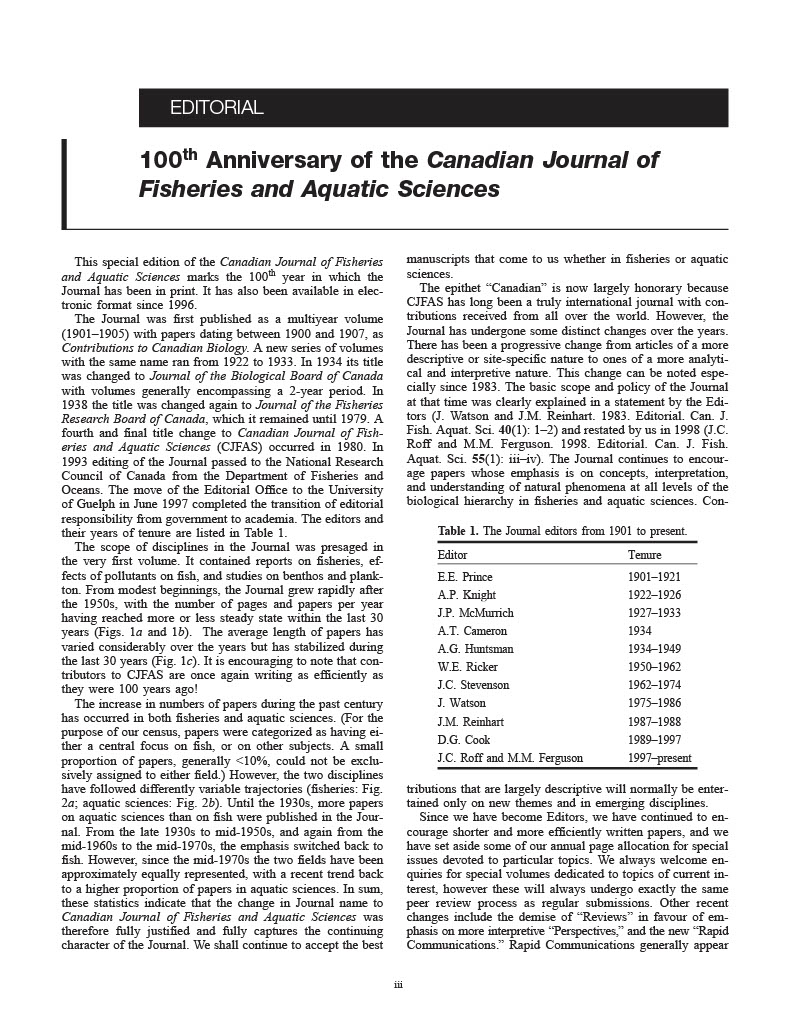 The first page the Roff and Ferguson’s 2001 anniversary editorial.
2010
Following a 2009 government review, the journal’s operations were transferred to the private sector. Canadian Science Publishing was incorporated as an independent not-for-profit and took over the publishing of CJFAS, among other journal titles familiar to researchers worldwide in the natural sciences.
2015
In 2015, George Rose and Sherrylynn Rowe published “Northern Cod Comeback,” a paper of ecological and cultural significance. It provided the primary documentation that the world’s largest cod stock (a global icon of fishery collapse) had begun to rebound after decades of attrition and a 32-year moratorium that banned cod fishing. Rose would go on to revisit the “Comeback” paper a decade later in the journal.
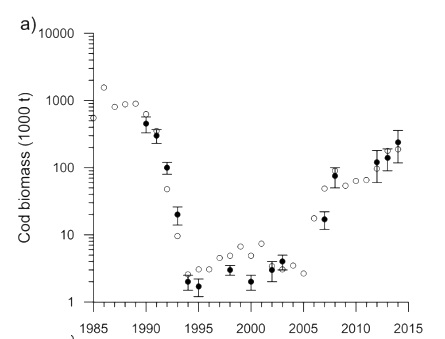 Figure 1a from Rose and Rowe, 2015, depicting the biomass of cod in the overwintering to spawning period within the Bonavista Corridor from 1990 to 2014.
 2017
One of the journal’s most downloaded papers, Diane Orihel et al.’s review of internal phosphorus loading in Canadian fresh waters addressed a critical aquatic science issue. As of late 2025, the paper had been downloaded ~14,000 times, highlighting its ongoing relevance to water quality research.
2022
The journal formalized a partnership with the newly formed Society of Canadian Aquatic Sciences (SCAS). This agreement built upon decades of informal relationships with the Canadian Conference for Fisheries Research (CCFFR) and the Society of Canadian Limnologists (SCL).
2025
In 2025, the journal launched a comprehensive collection reflecting on twenty years of Canada’s Wild Salmon Policy. When the policy was released, it was heralded as transformative, yet despite advances salmon populations continued to decline. The collection serves as a guide for the future, examining where federal policies have succeeded and failed to restore and maintain salmon populations as ecological pressures increased.
2026… and beyond
The journal celebrates its 125th anniversary.
The next century of progress
This achievement is made possible by the journal’s community. From the very beginning, the Canadian Journal of Fisheries and Aquatic Sciences has always been a collaboration. It began as a landmark effort to supervise government research with the help of knowledgeable experts and has evolved into a global scientific community. CJFAS’s mission continues through the dedicated efforts of independent editors and peer reviewers who volunteer their time and expertise, the commitment of our independent not-for-profit publisher, Canadian Science Publishing, our partners at the Society of Canadian Aquatic Sciences (SCAS), the researchers and practitioners from around the world who continue to push the field forward, and the next generation of early career researchers who will carry the aquatic sciences into the far future.
We invite everyone to join our community. Become a peer reviewer or guest editor, submit your next manuscript to CJFAS, subscribe to our newsletter, or follow us on social media. Join us as we work towards another century of progress!